TACTIC: children are the innocent victims of the capitalist system that adults have created. They are poor or rich by accidents of birth. Parents take poverty-wage jobs to give them a better life. But they often don’t have the time or income to look after them or send them to school, so they send them home to live with their grandparents. Adult supply chain workers themselves often started work as child labourers. Can their sacrifices give their kids a better life? Or are kids still having to work in global supply chains to help their families, or to survive themselves?
“Fazerin Sininen -suklaan Suklaakoulu-kampanja“ Fazer-yhtiön hyväntekeväisyyskeräyskampanja. Yllä oleva vaalikampanjamainos Helsingin Sanomissa.
Suomen suosituin suklaavalmistaja Fazer julkaisee koko etusivun ilmoituksen johtavassa päivälehdessä. Yritys lupaa lahjoittaa 5 senttiä jokaisesta myydystä Fazer Blue -suklaalevystä koulurakennushankkeeseen Norsunluurannikolla. Juuri siellä yrityksen kaakaopavut viljellään lapsiorjien voimin. Tarvitsevatko nämä lapset koulun vai jotain muuta Fazerilta?
Sivun viite: Eeva Kemppainen (2026) Fazerin Sininen -suklaan Suklaakoulu-kampanja. followthethings.com/fazer-blue-chocolate-cocoa-school-campaign.shtml (last accessed <insert date here>)
“Following the white phosphorus trail” A series of four TV news stories broadcast on Al Jazeera English. Embedded in the YouTube playlist above.
‘Follow the things’ trade justice activism tends to connect unknowing consumers to the exploited supply chain workers who make the things they buy. But not when it comes to the arms trade. Here, the direction of travel is reversed: it’s this industry’s ultimate ‘consumers’ – the people who are killed and maimed by these commodities – that activists are worried about, especially when their use can be considered a war crime. Since Hamas’ October 7th 2023 attack on Israel and the Israeli government’s military response (described by many, and denied by Israel, as a genocide), arms trade activists around the world have set out to make public the geographies of the arms trade supplying the Israel Defence Forces (IDF) and to disrupt this via non-violent direct action. They have also sought to hold arms manufacturers, shipping companies, Israeli and other goverments, and the IDF accountable for their actions under international law. But who are the people who make these weapons, where in the world? What do they know about the devastating impacts of their work? How do they feel about this? How do they rationalise it? Who’s responsible for this death and destruction? Soon after Hamas’ October 7th attack, news reports emerged that accused the IDF of using white phosphorus shells to bomb civilians in Gaza and Lebanon. These shells are designed to light up the sky, and/or to provide a smokecreen, for ground troops to more safely move into an area. That’s their permitted use. But if they’re used to bomb people, that’s a war crime. White phosphorus burns when it comes into contact with oxygen, and it keeps burning for weeks. It’s fat soluble so, if it lands on people’s skin, it burns and burns. Journalists and arms trade activists could identify where these white phosphorus shells were made from production codes they found on fragments of the shells found in burning ruins. An arsenal in the small town of Pine Bluff, Arkansas, USA, was the source. And not for the first time. In 2008-9, white phosphorus shells from the Pine Bluff Arsenal had been dropped on Palestinian civilians during the IDF’s ‘Operation Cast Lead’. The Quatari news station Al Jazeera sent a reporter there and broadcast at least four news stories that followed the trail of white phosphorus munitions there from Gaza. Reporter Mike Kirsch talked to locals, showed them images of Palestinian people burned by munitions made in their town, asked them what they felt about this, asked their mayor what he felt about this. There was a detailed Amnesty International report that he could show them. Were people in this town at least partially responsible for this death and destruction? Was the Arsenal responsible? Was the US government responsible? The IDF? Hamas? Here’s what we have been able to find.
Page reference: Ian Cook et al (2025) Following the white phosphorus trail. followthethings.com/following-the-white-phosphorus-trail.shtml (last accessed <insert date here>)
“Chocolate: Last Week Tonight with John Oliver (HBO)“ A monologue by John Oliver on his Last Week Tonight show broadcast in the USA on HBO. Full monologue posted on YouTube embedded above.
Satirist John Oliver is delivering his weekly monologue on late night American TV. It’s the day before halloween, where millions of chocolate sweets will be given to children knocking on doors in scary costumes [see our ‘Gifts & seasonal’ department for other Halloween examples]. But what’s scarier is the fact that the cocoa in that chocolate was probably picked by children in the Ivory Coast and Ghana in West Africa. Despite longstanding critiques of child labour in chocolate’s supply chains; despite legislation being passed to remove it; despite the major brands’ own schemes to eliminate it, child labour – and the modern slavery that often supplies it – persists in an industry that continues to make multi-$£billion profits. Oliver’s monologue is about consumers’ love of chocolate and the corporate evils that feed it. He combines acerbic takes on the chocolate corporations’ social responsibility rhetoric and advertising practices (including the distractions of a ‘f*@kable’ green M&M) with footage of filmmakers meeting children who pick cocoa, their families and communities. One clip of a Dutch journalist’s ‘gotcha’ moment with a Nestlé executive is particularly powerful. Admitting that coca farming communities suffered poverty and that’s why children had to work, the man from Nestlé abruptly ends the call when asked why he doesn’t just pay them more. That journalist went on to start his own ‘slave free’ chocolate company – Tony’s Chocolonely – which Oliver holds up as an exemplar. The chocolate business can work differently, because it is working differently. What’s needed to help this along – Oliver says – is regulatory change. With each episode of his show published on YouTube; with his use of humour to make depressing topics palatable to viewers; and with his championing of Tony’s – this was a provocative show. Commenters shared how much they loved Tony’s Chocolonely too, or that they were going to try some as a result of watching the show. Others criticised the writers for parroting Tony’s marketing materials, and pointed out that its journalist founder had left because Tony’s couldn’t make slave-free chocolate. Others said that other, more ethical, chocolate brands were available if you knew where to look. But, people chipped in, shopping differently isn’t the only way to tackle trade injustice. Trade justice can be achieved only via multiple forms of pressure, from multiple angles, constantly. And Oliver’s monologue didn’t help. Chocolate researchers criticised it for being full of the usual stereotypes. Cocoa farmers have never eaten chocolate? Nope. They may just pretend not to have eaten it for gullible Western filmmakers. And the writers bypassed – like most coverage does – those in producer countries who are trying to make a positive difference. For Oliver, it’s the Western brands and consumers who can save the day by acting more ethically. Yes, that’s very important. But it’s not enough. Can there be ethical consumption under capitalism? That’s the bigger question. It’s what everyone’s talking about here.
Page reference: Ian Cook et al (2025) Chocolate: Last Week Tonight with John Oliver (HBO). followthethings.com/chocolate-last-week-tonight-with-john-oliver-hbo.shtml (last accessed <insert date here>)
“The Nike Email Exchange (NEE)“ An email exchange between student Jonah Peretti and the Nike Corporation. The full email exchange was posted online on shey.net. Screengrab above. Read the whole exchange here.
Student Jonah Peretti experiments with Nike’s offer to customise its shoes with words you type into its ID website. Most people would add their name or their team’s name but he wants to add the word ‘sweatshop’ to a pair of running shoes. He wants to do this so that he can ‘remember the toil and labor of the children that made my shoes’. Nike say no. Peretti replies, arguing it’s OK. They say no. He replies again, saying he hasn’t breached their ID guidelines. They say no again. They just won’t let him do it. So he forwards the conversation to friends by email. They forward it to friends, who forward it to their friends, who …. It’s posted on a website called shey.net (above) and, within six weeks, millions have read it. Next, he’s invited onto national US TV to debate sweatshops with a Nike executive. This is one of the most iconic examples of viral online trade justice activism that happens 3 years before facebook is founded. It’s also an iconic example of the activist tactic of ‘culture jamming’ – turning a brand’s values and identity against itself. Peretti didn’t consider himself (or what he did) to be ‘activist’, he was just messing around with the opportunity that Nike gave its customer to personalise their shoes. What he did became known as the ‘Nike Email Exchange’ (or NEE) and was a important part of a swarm of public criticisms of Nike’s record on labour rights – including Indonesian Nike factory worker Cicih Sukaesih’s North American speaking tour [see our page here] – that cemented its sweatshop reputation in the late 1990s and 2000s. It’s also an iconic example in trade justice activism research. Peretti gave researchers Dietlind Stolle and Michele Micheletti the email addresses of everyone to whom he sent the email string, and everyone who replied to it. They got in touch to ask them about the impacts that it had had on them as citizens and consumers. The publications that emerged from this helped establish a significant body of scholarship on what’s called ‘political consumerism’. After becoming a public figure through the NEE, Peretti continued to experiment with viral online media before setting up Buzzfeed in 2006.
Page reference: Edward Jennings, Alex Hargreaves, Matt Goddard, Amy Joslin, Millie Whittington & Charles Bell (2024) The Nike Email Exchange (NEE). followthethings.com/the-nike-email-exchange-nee.shtml (last accessed <insert date here>)
“Maquilapolis (City Of Factories)“ A participatory documentary film in Spanish with Spanish or English subtitles directed by Vicky Funari & Sergio de la Torre, with music by Pauline Oliveros with the Nortec Collective & John Blue for the Independent Television Service & CineMamás Film. Trailer and pay-per-view stream embedded above. Search online for other streaming options here. Read the film transcript in English & Spanish here.
Carmen Duràn and Lourdes Lujàn work in Tijuana, the ‘city of factories’, on the Mexico-US border. They work in factories on the hill making televisions and other COMMODITIES for brands like Panasonic and Sony. These multinationals treat this city as a garbage can that their workers have to live in. How can they fight back, claim their rights, their humanity? They take part in a participatory filmmaking project with directors Vicky Funari and Sergio de la Torre. The directors have been working with a local collective of ‘promontoras’ including Carmen and Lourdes for years. They have planned this project together for years. There’s been some filmmaking training and the promontoras take camcorders into the places where they live and work. The films they make are full of personality and a close attachment to place. They document life from these factory workers’ perspective. They document the ways in which these multinationals treat them as workers – especially when they leave – and how they treat the place where they live – as a dump for industrial waste that ruins their environment and threatens their health. They document their campaigns to clean up toxic industrial waste. In the process audiences get to know Carmen and Lourdes, to empathise with them. But the film also contains some surprising and beautiful creative scenes – often made in place of the footage that’s impossible to take inside the factory – that look like performance art. They want to show the intimate, bodily connection between the labour they perform, the commodities you buy (or are treated with in hospital) and the brands that you may be familiar with. And there’s some specially commissioned film music, made with a local music collective and featuring sounds from the factories. This is a gem of a film for anyone interested in trade justice activism. This is the film – with caveats – that these Mexican factory workers wanted to make and to show to the world. It’s one of the most intimate place-based examples featured on our site. And it was shown, deliberately, to audiences of workers either side of the US-Mexico border. Seeing empowered women like themselves struggling, resisting was an inspiration to many other women. And when the film hit the film festival circle, and there were panel screenings, the promontoras were there, answering questions alongside the directors.
Page reference: Rosie Buller, Melanie Bonner, Rebecca Lyons, Georgie Little, Tilman Schulzklinger & Jennifer Hart (2020) Maquilapolis (City Of Factories). followthethings.com/maquilapolis-city-of-factories.shtml (last accessed <insert date here>)
“Jamelia: Whose Hair Is It Anyway?“ A TV documentary film fronted by Jamelia, directed by Jo Hughes, produced by Morgan Matthews for Minnow Films. Slideshow of documentary stills embedded above. BBC iPlayer page here. Watch on Box of Broadcasts (with institutional login) here.
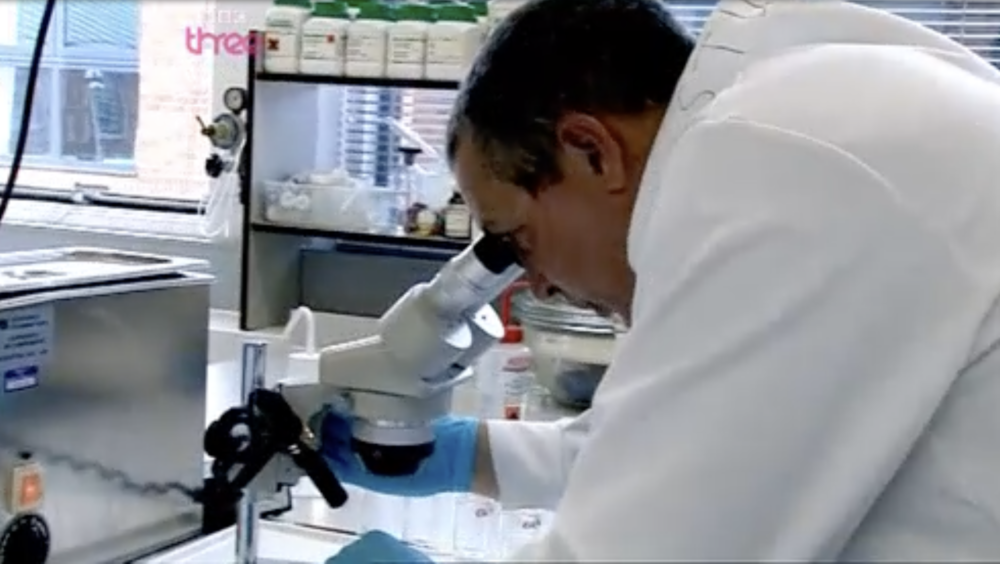
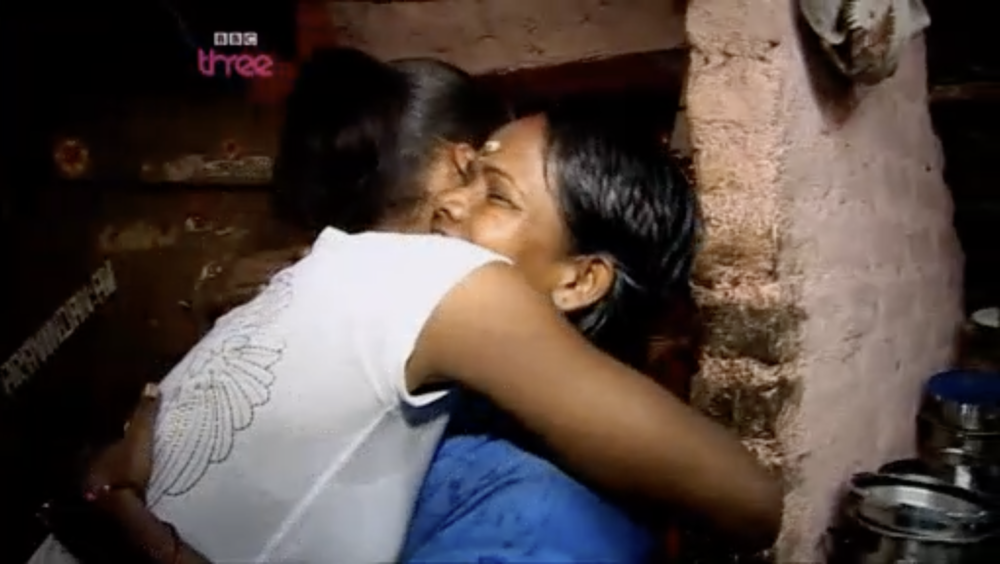
This is the example that inspired the first version of followthethings.com – an online list of ‘follow the things’ resources. In this TV documentary, legendary Birmingham pop singer Jamelia – best known for her 2010 song ‘Superstar’ – wants to find out about a hair extension that she wore on TV to present a National Lottery draw. It’s real human hair. Straight, long and black. But whose hair was it originally? Whose hair was she wearing? She asks some young women at a local school about where their extensions come from. They don’t know. Dead people? With the help of hair traders and a forensic scientist, she travels along human hair’s supply chains to find out if that’s true. First, she travels to Russia with a Russian hair trader. They drive to a village to buy the long and untreated hair of teenage girls (like Tatiana in the photo above). Their hair is worth a lot of money. Next, getting her hair forensically analysed in a lab provides some clues about its geographical origin. So, she travels to India, to the city of Chennai, and finds a woman whose hair she is convinced it originally was. But she hadn’t sold it. It had been shaved off at a temple, and the temple had sold it on. The money they made was used to feed the poor. So this isn’t a story of exploitation along supply chains that you might expect to find. Jamelia and the woman whose hair she probably wore bond over being mothers of daughters. The documentary turns into a kind of a reunion of long lost relations. This story has a happy ending and many of the people who comment on the film are suspicious of that. What have Jamelia and the film company brushed under the carpet? Do these following films always have to end up with depressing conclusions and appeals to consumers to do something for poor and powerless producers? A lot of the commentary is also about Jamelia and whether she is boycotting real hair now (like she allegedly said, or didn’t) or is a ‘hypocrite’ (that’s a criticism to expect of every example on this site). But there’s a final twist in this tale, that comes to the surface many years later. It’s a shocking example of a film like this making an impact. An important customer-base for Indian temple-sourced hair stops buying it. Because of a BBC documentary about the hair trade. It seems to be this one. Read on.
Page reference: Ian Cook et al (2020) Jamelia: Whose Hair Is It Anyway? followthethings.com/jamelia-who-hair-is-it-anyway.shtml (last accessed <insert date here>)
“Darwin’s Nightmare“ A documentary film directed by Hubert Sauper for Mille et Une Productions. Trailer embedded above. Search online for streaming options here.
Austrian filmmaker Hubert Sauper examines the effects of a fish that’s been introduced to the African Great Lake Victoria for commercial reasons. They’ve displaced other fish that local people rely upon for their diet and are farmed and flown away on cargo planes to be eaten by Northern consumers. More controversially, some of those planes (allegedly) return full of weapons that fuel civil wars in neighbouring countries. Here, capitalist and colonial logics create a place where Tanzanian fishermen, homeless children, prostitutes, government minsters, Russian pilots, World Bank officials, European Union commissioners live and work together in an ‘ungodly alliance’. Viewers say the film is clever, damaging and racist, and/or artfully depressing. Its director calls it a ‘feel bad’ movie. It’s nominated for an Oscar but loses to a penguin documentary. Northern consumers who love the Omega 3 in fish like Nile Perch start to boycott it, and sales are affected for a while. Darwin’s Nightmare makes Tanzania look terrible. Its government denounces the film, accuses its director of fabricating storylines (e.g the role of this arms trade plays in the spread of HIV), demands that he apologies and pursues the subjects of his film to punish them. Western governments learning about this arms trade from the film put pressure on Tanzania to stop it, and to stop silencing African journalists who have let the world know about it. One journalist criticises the film’s one dimensional portrayal of the hell caused in Tanzania by this fish trade. It’s a mixed picture. So much of its positive effects aren’t included. One critic is sued for calling the film a hoax. There are unprecedented personal attacks on the director, accusing him of acting unethically, threatening him with death and posting fake photos online of him with Saddam Hussein. The main criticism of his film is that it plays to centuries-old Western stereotypes of African savagery and backwardness. Critics say it reveals – but also helps to do – damage to the people of Tanzania. Sauper says he’s not found anything new. All he’s done is joined the dots between well known issues. Between the global arms and food trade, for example. It’s not an out and out activist film. It’s more of a film noir. No solutions are offered. So what responsibility do you have for the impacts of your film noir? Discussions of this film are super-heated.
Page reference: Aparupa Chakravarti & Jeff Bauer (2014) Darwin’s Nightmare. followthethings.com/darwins-nightmare.shtml (last accessed <insert date here>)
“Fazer ‘Blue’ Chocolate Cocoa School Campaign“ A corporate charity fundraising campaign by Fazer. Campaign advert in Helsingin Sanomat above.
Finland’s favourite chocolate company Fazer takes out a full front page ad in a leading daily newspaper. They promise to give 5 cents from every bar of Fazer Blue to a school building project in the Ivory Coast. This is where the company’s cocoa beans are grown by child slaves. Do these children need a school or something more from Fazer?
Page reference: Eeva Kemppainen (2024) Fazer ‘Blue’ Chocolate Cocoa School Campaign. followthethings.com/fazer-blue-chocolate-cocoa-school-campaign.shtml (last accessed <insert date here>)
“Diamonds From Sierra Leone“ A music video starring Kanye West & Jay-Z, directed by Hype Williams, music by Kanye West, Jon Brion & Devo Springstein, for Roc-A-Fella Records. Original video and remix audio embedded above.
Kanye West is writing and recording a new song commemorating the rebirth of his label Roc-A-Fella Records, including conflicts within the organisation whose hand-signal is the shape of a diamond. Q-Tip, a former member of A Tribe Called Quest, then alerts him to the ‘blood diamond’ scandal in Sierra Leone. So West changes the title of the track to ‘Diamonds from Sierra Leone’ and makes a powerful black and white music video about the supply chain linking the country’s child diamond miners to wealthy white diamond consumers shopping in high end jewellery stores in the USA. One scene parodies a 1990s De Beers’ engagement ring advert, except for the blood that drips from the engagament ring once it’s slipped onto a woman’s finger. In another, a black child’s hand appears from beneath the counter in a jewellery store and hands a diamond to the dealer to hand to a shopper. Later, West leaps from a convertable James Bond-type just before it crashes through the jewellery store window. The video ends with an on-screen plea: ‘please buy conflict free diamonds’. Some audience members point out how a diamond-encrusted mask that West wears on stage, and the bling culture he brags about, makes this plea a bit hypocritical. Others point out a disconnect between the message in the lyrics (about internal record label conflicts) and in the video (about international supply chains and trade injustice). Some core fans aren’t impressed by the track’s sampling Shirley Bassey’s ‘Diamonds Are Forever’ (or harpsichords). So, although West returns to recording more conventional tracks – like his 2005 Crack Music – that his fans want to hear, audience members do start to question the origins of their diamonds (especially after West issues a remix whose lyrics are more directly about the the topic). The video becomes a global smash which – along with Leonardo Di Caprio’s (2006) film Blood Diamond – makes this exploitative trade so public that the industry has to respond. Is this an example of celebrity-fronted trade justice activism that has succeeded, despite – or maybe because of – its flaws? Is this another Global North charity-style representation of abject, improverished life in the Global South that’s caused by guilty, and only solvable through responsible, Western consumerism? Or do its scenes of the child miners and West working together to disrupt diamond supply chains show the kind of ‘global racial solidarities’ that could be mobilised to address this trade injustice? See what you think by reading the comments below.
Page reference: Hector Neil-Mee, Hannah Willard, James Kemp, Harvey Dunshire, Maddy Morgan & Luke Jarvis (2026) Diamonds From Sierra Leone. followthethings.com/diamonds-from-sierra-leone.shtml (last accessed <insert date here>)
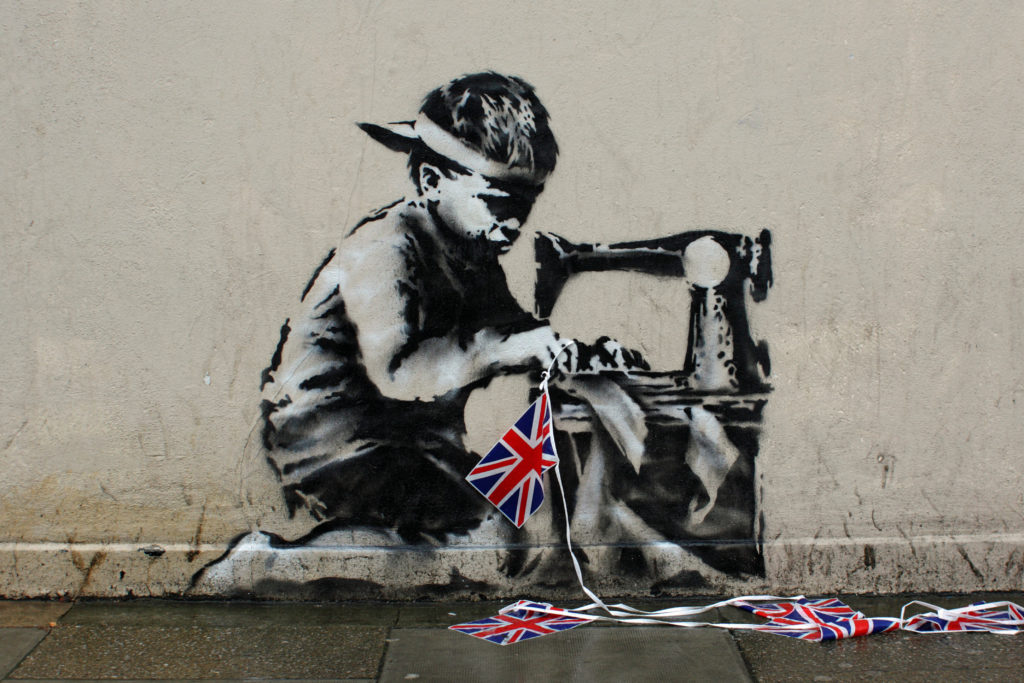
“Banksy’s Slave Labour“ Street art by Banksy. Photo of the original artwork in situ above. Whereabouts and condition currently unknown.
It’s 2012. Queen Elizabeth’s Diamond Jubilee is being celebrated in the UK. The London Olympics are also taking place. There’s Union Jack bunting everywhere. It’s cheaply and readily available in discount stores like Poundland. Including one in Wood Green, South London. Along a street where the Olympic torch relay may have passed. This is where the anonymous celebrity British street artist Banksy paints a mural of a child hunched over a sewing machine, making this bunting in India. Physical bunting is part of the work. It’s hung up on the wall and spills onto the pavement. Banksy, as usual, explains little or nothing. Commentators say it’s inspired by a 2010 exposé of child labour in Poundland’s supply chains. Like other examples of Banksy’s street art, it quickly makes the news, people visitfrom afar, locals claim it as theirs, and it’s stolen and auctioned on the international art market. Trade justice activists love it when their work goes viral. This story was everywhere. This image of child labour in pound shop supply chains was reproduced countless times. But this viral story wasn’t, unfortunately, about trade injustice. It did’t put pressure on Poundland, or any other retailer, to remove child labour from their supply chains, to improve workers’ pay and conditions, or to achieve any other trade justice goal. The story that went viral was about this Banksy being stolen and auctioned in Miami the following year and, later, in London for hundreds of thousands of dollars. It’s about who owns this work, who has the right to sell it, where it belongs and the irony of an artwork that critiques commodity cultrure becoming a commodity. Local residents argue that the work only makes sense in situ (a point that Banksy makes about all of his street art). It’s never returned but countless people around the world have not only seen it but also bought it. You can buy Slave Labour as a sticker, an ornament to hang on your Christmas tree, a framed print to hang on your wall, a stencil or wallpaper mural to recreate it on your wall. Because of the controversy about its removal and sale, it has become one of Banksy’s most iconic works. And the wall where it was originally posted is still haunted by its presence, with countless grafitti artists adding copies, versions and alternatives there. This is one of the most famous examples of trade justice art-activism. Banksy lending his celebrity status to the cause brought it into the media spotlight for months. But there’s no evidence that this helped to improve the pay and conditions of workers, younger and older, in pound shop supply chains. So what can we learn from what did and didn’t happen here? What could and couldn’t happen?
Page reference: Lydia Dean, Lucinda Armstrong, Jessica Bains-Lovering, Emily Hill, Harriet Allen & Rose Cirant-Carr (2025) Banksy’s Slave Labour. http://followthethings.com/banksy-slave-labour.shtml (last accessed <insert date here>)
Contains information about the traffic source or campaign that directed user to the website. The cookie is set when the GA.js javascript is loaded and updated when data is sent to the Google Anaytics server
6 months after last activity
__utmv
Contains custom information set by the web developer via the _setCustomVar method in Google Analytics. This cookie is updated every time new data is sent to the Google Analytics server.
2 years after last activity
__utmx
Used to determine whether a user is included in an A / B or Multivariate test.
18 months
_ga
ID used to identify users
2 years
_gali
Used by Google Analytics to determine which links on a page are being clicked
30 seconds
_ga_
ID used to identify users
2 years
_gid
ID used to identify users for 24 hours after last activity
24 hours
_gat
Used to monitor number of Google Analytics server requests when using Google Tag Manager
1 minute
_gac_
Contains information related to marketing campaigns of the user. These are shared with Google AdWords / Google Ads when the Google Ads and Google Analytics accounts are linked together.
90 days
__utma
ID used to identify users and sessions
2 years after last activity
__utmt
Used to monitor number of Google Analytics server requests
10 minutes
__utmb
Used to distinguish new sessions and visits. This cookie is set when the GA.js javascript library is loaded and there is no existing __utmb cookie. The cookie is updated every time data is sent to the Google Analytics server.
30 minutes after last activity
__utmc
Used only with old Urchin versions of Google Analytics and not with GA.js. Was used to distinguish between new sessions and visits at the end of a session.
End of session (browser)
Vimeo is a video hosting platform for high-quality content, ideal for creators and businesses to showcase their work.
Registers a unique ID on mobile devices to enable tracking based on geographical GPS location.
1 day
VISITOR_INFO1_LIVE
Tries to estimate the users' bandwidth on pages with integrated YouTube videos. Also used for marketing
179 days
PREF
This cookie stores your preferences and other information, in particular preferred language, how many search results you wish to be shown on your page, and whether or not you wish to have Google’s SafeSearch filter turned on.
10 years from set/ update
YSC
Registers a unique ID to keep statistics of what videos from YouTube the user has seen.
Session
DEVICE_INFO
Used to detect if the visitor has accepted the marketing category in the cookie banner. This cookie is necessary for GDPR-compliance of the website.
179 days
LOGIN_INFO
This cookie is used to play YouTube videos embedded on the website.