Posted on

No one can live with Swiss Chocolate!

followthethings.com
Gifts & Seasonal

“No one can live with Swiss Chocolate!”
A campaign by the Swiss NGO Erklärung von Bern (EvB, known since 2016 as Public Eye) – called ‘Mit Schweizer Schoggi kann niemand leben!’ (‘No one can live with Swiss Chocolate!’) – comprising a research report, a guide, two spoof video advertisements & a public action.
Videos embedded above in full. Download the research report here and the guide here (both in German).

Trade justice activists not only need to choose the right things to grab public attention, they also need a good sense of both place and time. Whichever country your NGO is based in, find out what its iconic commodities are – like Switzerland and chocolate. Research what its brands and manufacturers are doing to reduce exploitation in their supply chains, and launch your findings in the lead-up to an annual event where that commodity plays a huge part – like chocolate at Easter. Choose an iconic example of that commodity – like a chocolate Easter Bunny – that’s a signature product for one of your target companies – like Lindt with its Gold Bunny (the one with the bell around its neck). If it’s an human or animal character, use animation to bring it to life and invite members of the public to empathise with how ‘he’ or ‘she’ might feel if they found out the true story of their origins. Broadcast campaign ads featuring them finding this out on TV and at the cinema. Encourage people to sign a facebook petition demanding the companies’ supply chains be less exploitative – by sourcing more Fair Trade chocolate. Show that this is possible by making and selling a less explotative version of their signature commodity yourself – by printing out the petition signatures on a giant Fair Trade chocolate bar and giving that bar to the CEO of one of the worst-ranked companies at a public event. Show that your company rankings come from a solid research report based on a questionnaire sent to all of them asking what they have put in place to address the well known exploitations in their industry’s supply chains. Categorise each company’s response as ‘advanced’ (doing good things), ‘so-so’ (doing something but not enough) and ‘refused to take part’ (not returning the questionnaire). Make these rankings public and invite the companies to respond. What’s fascinating about this approach to activism is that it can effectively bring trade injustice into public debate – how supply chains work, what exploitations they contain, who and what causes them, how they can be addressed, and by whom? Companies can get cross with NGO that do this. They can argue that the assessments were unfair and inaccurate, and that they’re doing more than they are credited with. The NGOs can then publicly respond to these new claims, draw critical attention to them, question their assumptions, ask if there are deeds as well as words in them. What to many people might normally be inaccessible and overly-complicated explanations of labour rights and supply chain economics are easier can become more meaningful when things happen this way, because of the drama, the WTF-is-happening-to-things-I-love (material cultural) approach! With this example, we’re looking not at one piece of trade justice activism, but at three or four different pieces that were designed to work together (and as part of a long-running campaign, including things that have happened since). Pretty much every example of trade justice activism on our site has English as its first language. Here, we’re in Switzerland, so we’ve used online tools to translate the comments below from German and French (with a little Italian) into English. See what you think.

Page reference: Ian Cook et al (2026) No one can live with Swiss Chocolate! followthethings.com/no-one-can-live-with-swiss-chocolate.shtml (last accessed <insert date here>)

Estimated reading time: 53 minutes.

Continue reading No one can live with Swiss Chocolate!

Loading

Posted on

‘I Found This In A Box Of Halloween Decorations’

followthethings.com
Gifts & Seasonal

“I Found This In A Box Of Halloween Decorations”
A letter written by ‘Mr Zhang’ (Sun Yi) in a Chinese prison factory and found in a box of Kmart Halloween decorations bought in Oregon, USA by Julie Keith.
Original letter recieved by Julie Keith and posted online shown above.

In 2013, shopper Julie Keith is unpacking a box of styrofoam Halloween decorations she bought from her local K-Mart. In between the ghoulish plastic gravestones, she finds a folded-up letter. It’s written in English by someone who says that they’re a prison factory worker in China who has helped to make this product. They give the address of the prison (called Masanjia) and say that its inmates work long hours and have been tortured, beaten and insulted. It asks its recipient to forward the letter to the ‘World Human Rights Organisation’. Julie thinks it’s genuine and posts a photo of the letter on her facebook with the caption ‘I found this in a box of Halloween decorations’. It gets a flurry of responses. Is it genuine? What should she do with it? There isn’t a ‘World Human Right Organisation’. The discussions spread. The post is shared many times. Soon it’s being reported on the local TV news. Next it’s a global news story. Who is this person? How did they write this note? How did they smuggle it into a box of Halloween decorations? How many letters did they write? What did they hope would happen? What danger were they in for doing this? Can journalists find the author and verify the story? And, most importantly, why are ‘made in China’ goods coming from prison labour? Isn’t that illegal?

NB a documentary film about this letter was released in 2018. We will add a page on its making, reception and impacts soon.

Page reference: Harry Marriot, Alex Partington, William Finley, Milly Bowen, Sarah Murray & Jenny Sharp (2014) ‘I Found This In A Box Of Halloween Decorations’. followthethings.com/i-found-this-in-a-box-of-halloween-decorations.shtml (last accessed <insert date here>)

Estimated reading time: 34 minutes.

Continue reading ‘I Found This In A Box Of Halloween Decorations’

Loading

Posted on

Radi-Aid: Africa For Norway

followthethings.com
Home & Auto

“Radi-aid: Africa For Norway
NGO video campaign by and for The Norwegian Students’ & Academics’ International Assistance Fund (SAIH).
Video playlist embedded above. Campaign website here.

It’s unusual to find a humanitarian campaign where people in the Global South take pity on people in the Global North and send them aid in the hope that it will improve their miserable, pitiless lives. The kind citizens of many African countries, blessed with warmth that many take for granted, get together to help the people of Norway who are suffering terribly from freezing cold temperatures. What better to send them? Electric radiators. Charity workers collect and deliver them to grateful aid recipients. They even record a charity single and video to raise awareness and funds, like Band Aid’s ‘Do they know it’s Christmas?’ or USA for Africa’s ‘We are the world’. Their song is just as awful. Just as patronising. Just as one dimensional. Just an inaccurate. Just as tear-jerking. This is a campaign by a Norwegian development NGO that wants to challenge the ‘white saviour complex’ that so much European development NGO fundraising is based upon. What if the tables were turned? What if you were represented in the way that you represent others? What if you found that offensive, partial, ridiculous? Would that lead you to think differently about humanitarian aid, the way it is represented in charity ads, and the things that its NGOs send to people who it sees as needy? Like goats. This campaign, and particularly the video for its charity single ‘Africa for Norway’, went viral. This became a very public debate. Who could have imagined that a gift of radiators could have been so effective?

Page reference: Marie Conmee, Rebecca Jones, Frederic Montaner-Wills, Thomas Paulsen, James Pidding, Hannah Rusbridge & Joe Shrimpton (2016) Radi-Aid: Africa For Norway (taster). followthethings.com/radi-aid.shtml (last accessed <insert date here>)

Estimated reading time: 9 minutes.

Continue reading Radi-Aid: Africa For Norway

Loading

Posted on

Planet Money Makes A T-Shirt

followthethings.com
Fashion

Planet Money Makes A T-Shirt
A podcast series, webdoc & YouTube playlist in NPR’s ‘Planet Money’ series produced by Alex Blumberg.
YouTube playlist embedded above. Listen to the Podcast series here. Visit the webdoc here. Visit the NPR store here.

The USA National Public Radio’s ‘Planet Money’ plans a series of programmes on the international cotton industry, from seed to t-shirt. But they’re not interested in investigating who makes K-Mart or Walmart or H&M t-shirts. Instead, they launch a kickstarter campaign. If enough people pledge $25, their reporters will travel the world to find out who makes a T-shirt that they commission. This means that they can talk directly to farmers, factory owners, workers, shippers and others involed in bringing that shirt to the market. If they find stories of environmental or labour exploitation, it’s their own brand that will be damaged. 25,000 are made. Each features a squirrel hoisting a martini glass (a jokey reference to what economist John Maynard Keynes referred to as capitalism’s ‘animal spirits’). Each pledger was sent a t-shirt as a reward for their investment. Other people could buy one from NPR’s online store.

Page reference: Emelia Price, Steph Small, Sophie Blakstand, Maisie Jenyon, Catt Suttie, Hannah Cookson, Laura Johnston & Abigail Spink (2025) Planet Money Makes A T-Shirt (taster). followthethings.com/planet-money-makes-a-t-shirt.shtml (last accessed <insert date here>)

Estimated reading time: 8 minutes.

Continue reading Planet Money Makes A T-Shirt

Loading

Posted on

The Accord On Fire & Building Safety In Bangladesh

followthethings.com
Fashion

The Accord On Fire & Building Safety In Bangladesh
An independent legally binding global framework agreement between fashion brands, retailers & trade unions.
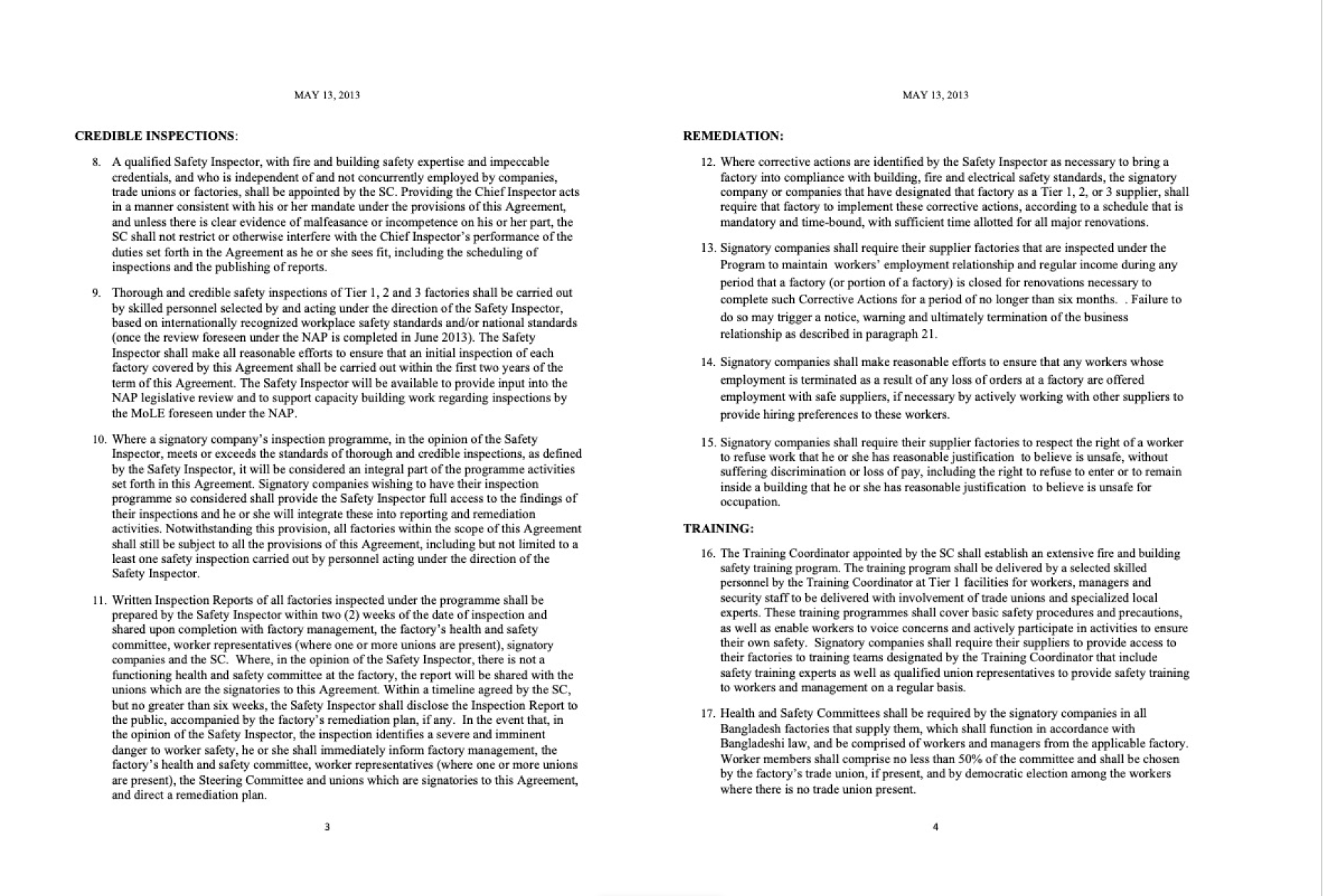
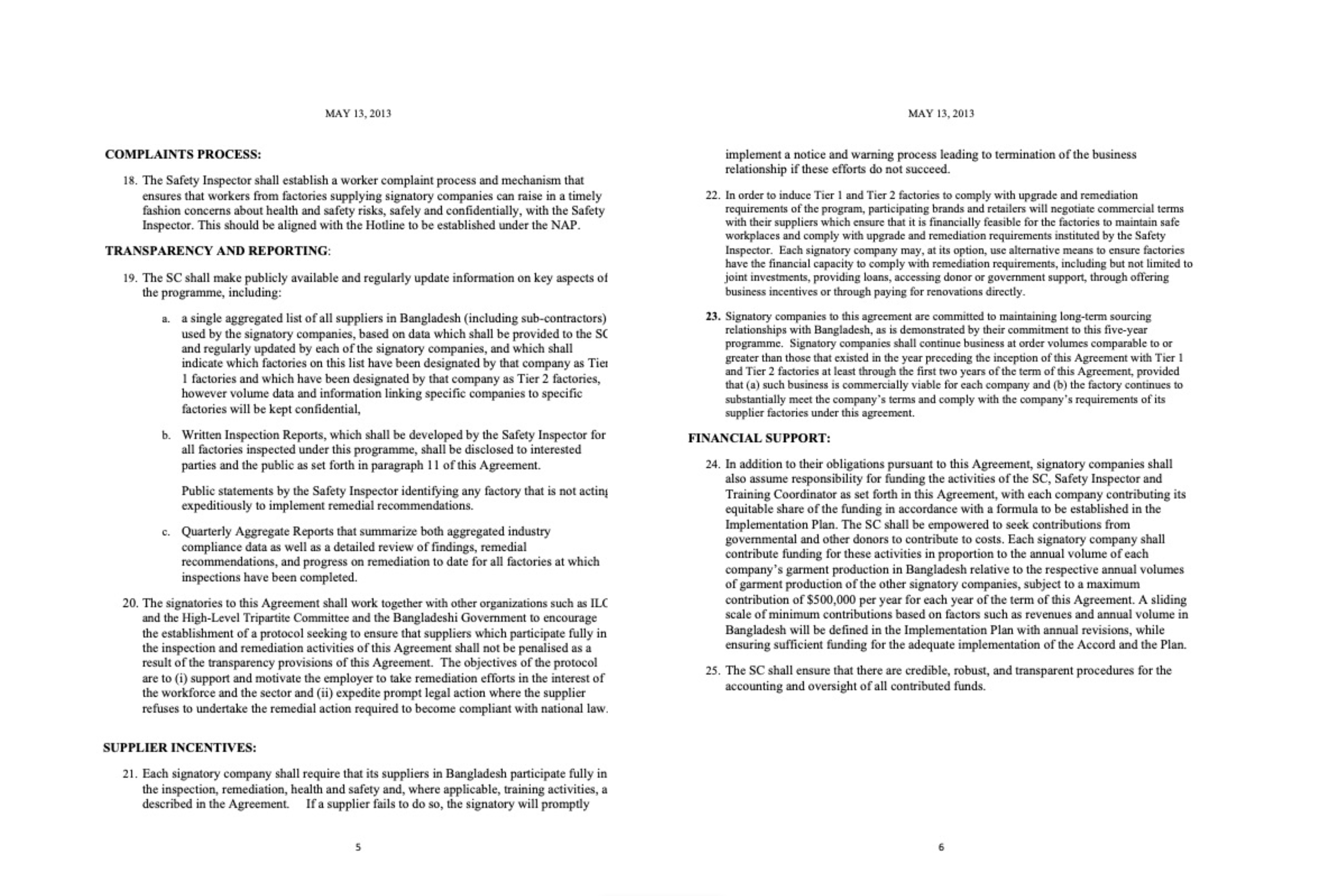
Click the screengrabs to read the agreement on IndustriALL Global Union’s website.

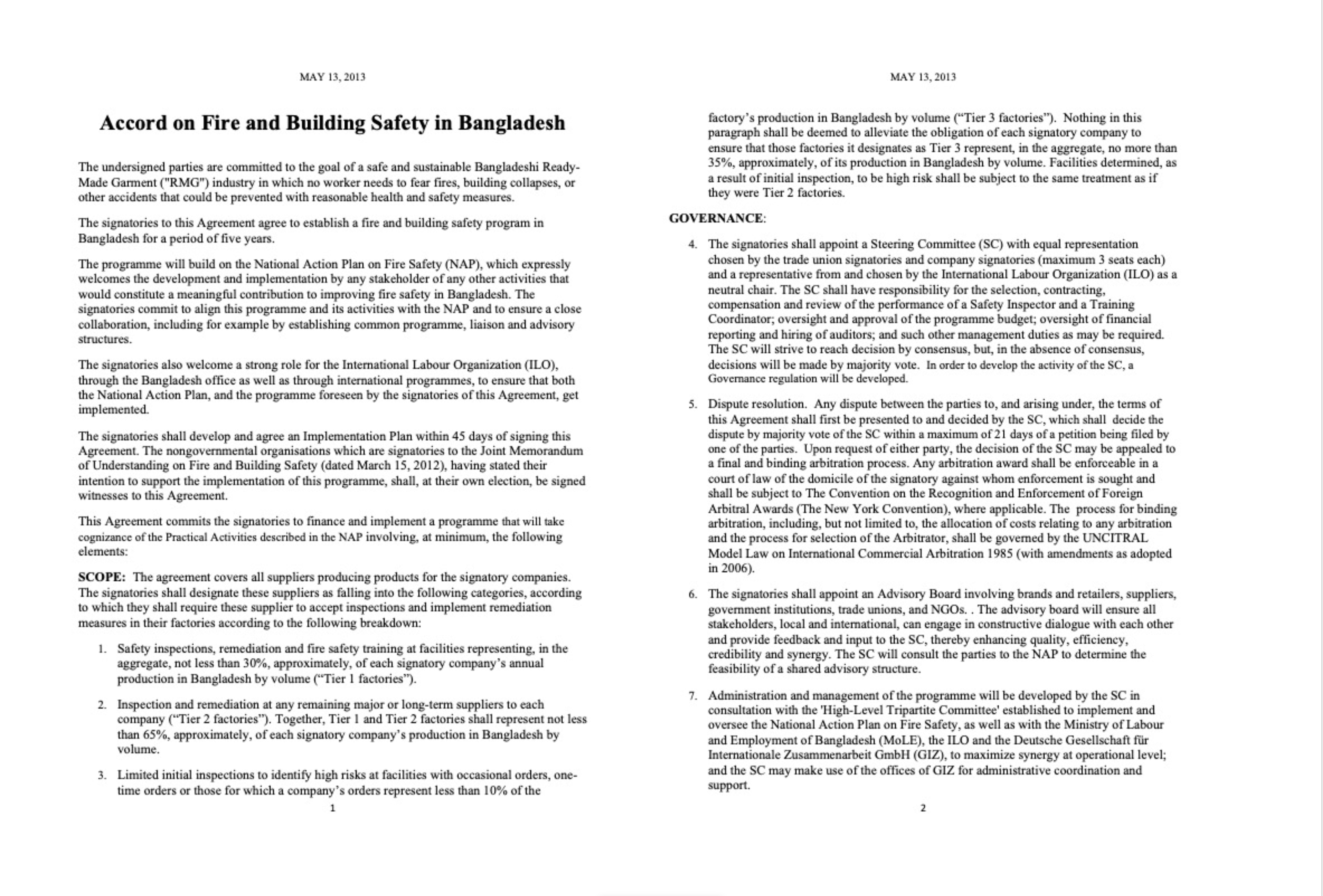
What if brands, retailers and labour unions could agree on a ways to ensure the safety of millions of people working in garment factories to prevent the factory fires and collapses that have killed and injured so many? They did, in the wake of the Rana Plaza factory complex collapse in Dhaka, Bangladesh in April 2013 where more than 1,100 garment workers making clothes for Western high street brands were crushed to death. Under this agreement, health and safety committees would be democratically elected in all factories and would identify and take action relating to concerns they identified. Factories would have independent safety inspections. The results and corrective actions outlined in these reports would be made public. The brands signing the agreement would continue to have their clothes made in the unsafe factories and would fund the corrective actions to make them safer. And factory workers would be trained in health and safety, could make complaints without fear of reprisal and could refuse to work in unsafe conditions. Wow! Could this work? Would brands sign up? Would workers see the benefits? What would happen 5 years later, when the agreement ran out? Could workers in other countries benefit from the same kind of agreement?

Page reference: Chris Crane, Alex Danvers, Robbie Foley, Will Kelleher, Mike Stanton & Adam Williams (2013) The Accord On Fire & Building Safety In Bangladesh (taster). followthethings.com/the-accord-on-fire-building-safety-in-bangladesh.shtml (last accessed <insert date here>)

Estimated reading time: 13 minutes.

Continue reading The Accord On Fire & Building Safety In Bangladesh

Loading

Posted on

Handprint

followthethings.com
Fashion

Handprint
A short fashion film by Mary Nighy for Livia Firth’s EcoAge consultancy.
Uploaded to YouTube & embedded in full above.

The elegant, graceful actor and model Eletrra Wiedemann, wrapped in a towel after a brisk shower, walks through her beautiful apartment, designer clothes strewn everywhere. As she chooses a red dress, other people’s hands appear to help her get it on, her jewellry on, her shoes on. She doesn’t flinch until she sees the people whose hands these were in a mirror. This film isn’t about the footprint of her clothes. It’s about the handprint. These are the people who made them for her. In the room. With her. Helping her to get dressed. Every day. She couldn’t do it without them. Gulp. This film was made for an exclusive fashion industry audience to encourage them to take care of supply chain workers in the wake of the Rana Plaza factory collapse. It was later published online for a wider audience. What impacts could this vision have on them? What can we find out?

Page reference: Ian Cook et al (2025) Handprint. followthethings.com/handprint.shtml (last accessed <insert date here>)

Estimated reading time: 43 minutes.

Continue reading Handprint

Loading

Posted on

Pipe Trouble

followthethings.com
Home & Auto

Pipe Trouble
A tablet video game by Alex Jansen in partnership with Jim Munrow for Pop Sandbox.
Gameplay video embedded above. No longer available from the iTunes Store

A documentary about laying gas pipelines across Canada is made for TV. To complement it, a computer game is commissioned. It’s based on the documentary’s research and the Pipe Mania game that came free with every copy of Windows 3.1. Your task? To lay a pipe from one side of the screen to the other. To keep your boss & local farmers happy. To make money. To get bombed by ‘ecoterrorists’. Critics said a video game that could be used to train eco-terrorists was sick. But had they played the game?

Page reference: Jenny Hart (2018) Pipe Trouble. http://followthethings.com/pipe-trouble.shtml (last accessed <insert date here>)

Estimated reading time: 27 minutes.

Continue reading Pipe Trouble

Loading