
Posted on

Flip-flop: a journey through globalisation’s backroads

followthethings.com
Fashion

“Flip-Flop: A Journey Through Globalisation’s Backroads“
A multi-sited ethnographic research monograph by Caroline Knowles (with photographs by Michael Tan), published by Pluto
Preview above. Available from good bookstores. Website here.

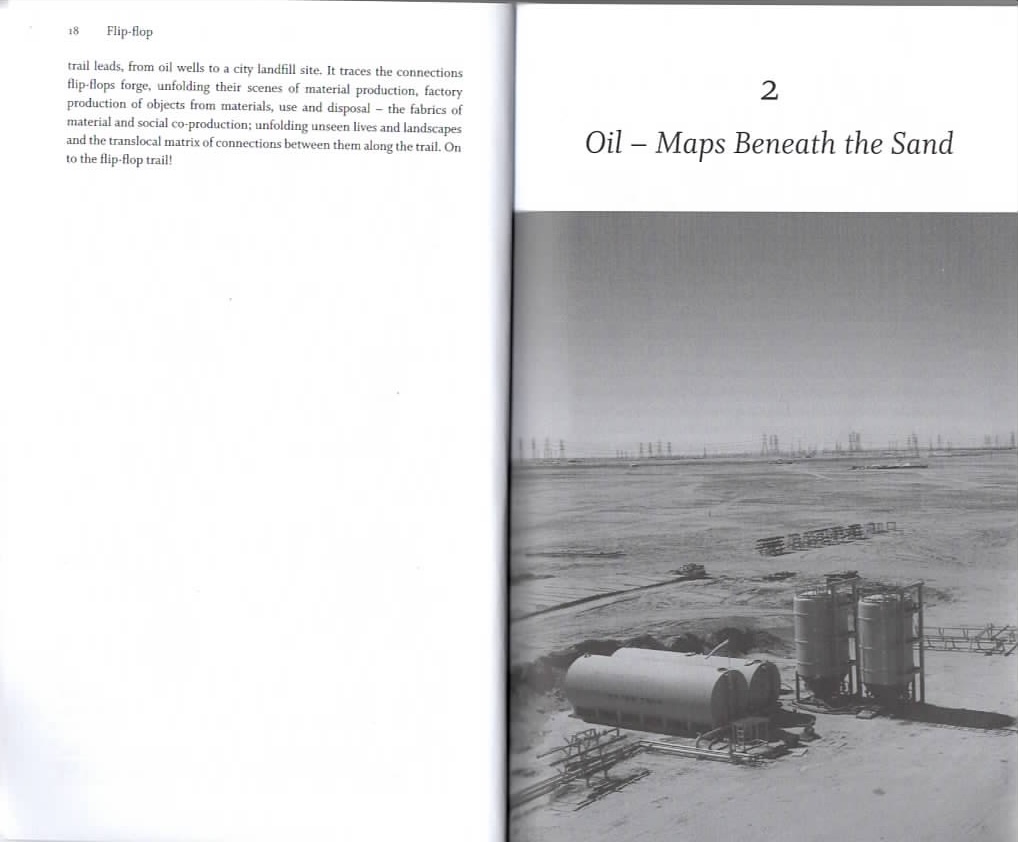
When academics, journalists, filmmakers and other thing-followers choose the commodity they will delve into, it’s often something important, something they couldn’t live without. Caroline Knowles takes a different approach, choosing something she doesn’t think about much, something that’s sitting at the back of her closet, something she uses only occasionally. It’s a great idea. Following different commodities brings lots of different materials, places, and people together in one story. There will inevitably be surprises. But she’s not following them back from her closet to the factories where they were made in the Global South. She’s following them forward. From the oil wells of Kuwait, to the petrochemical plants in South Korea that turn this oil into the right kind of plastic that can be shipped as granules, to the factories in China where they are turned into flip-flops, which are then shipped for sale and walking about in Ethiopia. She uses this on-the-ground following to reflect on globalisation. It’s a more complex process than many think it is. It looks this way when you follow things, especially if you de-centre the Western consumer, follow South-South trade, and connect different sites, people and places. The ‘guilty Western consumer’ is nowhere to be seen. So what can this approach tell us about trade justice? In what ways might it be, and contribute to, its activism?

Ian Cook et al (2026) Flip-Flop: A Journey Through Globalisation’s Backroads (under construction). followthethings.com/flip-flop.shtml (last accessed <insert date here>)

Estimated reading time: tbc minutes.

Continue reading Flip-flop: a journey through globalisation’s backroads

Loading

Posted on

Employee Visualisation Appendage

followthethings.com
Fashion

“Employee Visualisation Appendage“
A conference talk prank by The Yes Men at a ‘Textiles of The Future’ conference in Tampere, Finland – filmed & featured in ‘The Yes Men’ movie.

Cultural activists and ‘identity correctors’ The Yes Men set up a fake World Trade Organisation (WTO) website and offer a man called Hank Hardy Unruh to speak at conferences on its behalf. The organisers of a ‘Textiles of the Future’ conference in Finland believe the website is genuine and invite him to give a talk. In the conference hall, the audience watch his assistant ripping off his business suit to reveal a gold lamé telematic suit underneath from which he inflates a huge phallus. This ’employee visualisation appendage’, they say, will allow future managers to give electric shocks to sweatshop workers when their productivity levels dip. To the Yes Men, this gold lamé performance exaggerates to ridiculous proportions the inhumanity of the WTO’s neo-liberal ideology and its dehumanisation of supply chain workers. It’s outrageous and kind of obscene (both the ideology and their performance). Movie audiences find it hilarious. But why is there such a muted reaction in the hall? And what impacts (if any) might these reactions have on the lives of workers in textile supply chains? This compilation page is arranged a little differently than others on our website because this prank had two audiences: the conference delegates and the movie audiences. We find this example fascinating. It’s fair to say that it’s memorable. But where – and upon whom – did it make an impact?

Page reference: Tom Best, Tom Gibson, Beth Massey, Chloe Rees, Kate Ross & Jemma Sherman (2019) Employee Visualisation Appendage. followthethings.com/employee-visualisation-appendage.shtml (last accessed <insert date here>)

Estimated reading time: 47 minutes.

Continue reading Employee Visualisation Appendage

Loading

Posted on

The True Cost

followthethings.com
Fashion

“The True Cost“
A documentary film (with website) directed Andrew Morgan & executive produced by Livia Firth for Life Is My Movie Entertainment.
Available in full on YouTube (embedded above). Website here.

American filmmaker Andrew Morgan weeps in a New York Starbucks after seeing a front page newspaper story about the collapse of the Rana Plaza factory complex in Dhaka, Bangladesh where over 1,100 garment workers were crushed to death making clothes for Western high street retailers and brands. It’s illustrated with a photos two young boys looking at photos the of missing, assumed dead, workers pinned up near the site. They are the same age as his sons and are looking for their missing mum. He is shocked to his core. How could something this atrocious be allowed to happen? He imagines making a film that will answer this question and sets up a kickstarter campaign to raise the money to finance it. He doesn’t believe that there’s an individual or organisation who, alone, could have saved those people’s lives by acting differently (like consumers, for example). So he travels to lots of places in fashion’s supply chains. He talks to workers, farmers, managers, retired executives, ethical fashion pioneers, NGO execs, journalists, doctors and academics. Viewers get to know some – like Shima Akhter the garment factory worker in Bangladesh and LaRhea Pepper the cotton farmer in the USA – better than others. He makes the argument that Rana Plaza was a systematic failure. This film’s networky trade justice activism shows how everyone in the industry could and should act differently to make things better. Some, as his film shows, are already doing so. But can it encourage more people to get involved in the systemic change that’s needed? Who needs to see it? Where? There’s a lot of detail to digest here! Maybe too much. This film generated more discussion than any example researched on our website so far.

Page reference: Olivia Dubec, Sophie Rees, Amelia Daniel, Becca Craig, Ellie Glynn, Frankie Ward & Katy Jackson (2020) The True Cost. followthethings.com/the-true-cost.shtml (last accessed <insert date here>)

Estimated reading time: 146 minutes

Continue reading The True Cost

Loading

Posted on

The Box

followthethings.com
Ship my order

“The Box“
A global multi-media / multi-platform journalism project by the British Broadcasting Corporation (BBC), managed by the Container Shipping Information Service.
BBC News project outline embedded above. Project homepage here. ‘Latest location’ map page here (screengrab below). Download the template to make your own BBC ‘The Box’ container model here.

The BBC paints a 40′ shipping container with its distinctive livery and logo. They attach a GPS transmitted to follow its travels over land and sea. Each time it is loaded or unloaded, its journalists meet the workers, consumers and others whose lives are connected through its travels. What they find is logged live on an interactive map. Ship-spotters are tasked to find and photograph it. A unique high-tech collaborative research project emerges. It’s used by teachers to make trade a ‘live’, exciting topic. So what can it tell us?

Page reference: Tommy Sadler (2013) The Box. followthethings.com/thebox.shtml (last accessed <insert date here>)

Estimated reading time: 54 minutes.

Continue reading The Box

Loading