

followthethings.com
Gifts & Seasonal
“No one can live with Swiss Chocolate!”
A campaign by the Swiss NGO Erklärung von Bern (EvB, known since 2016 as Public Eye) – called ‘Mit Schweizer Schoggi kann niemand leben!’ (‘No one can live with Swiss Chocolate!’) – comprising a research report, a guide, two spoof video advertisements & a public action.
Videos embedded above in full. Download the research report here and the guide here (both in German).
Trade justice activists not only need to choose the right things to grab public attention, they also need a good sense of both place and time. Whichever country your NGO is based in, find out what its iconic commodities are – like Switzerland and chocolate. Research what its brands and manufacturers are doing to reduce exploitation in their supply chains, and launch your findings in the lead-up to an annual event where that commodity plays a huge part – like chocolate at Easter. Choose an iconic example of that commodity – like a chocolate Easter Bunny – that’s a signature product for one of your target companies – like Lindt with its Gold Bunny (the one with the bell around its neck). If it’s an human or animal character, use animation to bring it to life and invite members of the public to empathise with how ‘he’ or ‘she’ might feel if they found out the true story of their origins. Broadcast campaign ads featuring them finding this out on TV and at the cinema. Encourage people to sign a facebook petition demanding the companies’ supply chains be less exploitative – by sourcing more Fair Trade chocolate. Show that this is possible by making and selling a less explotative version of their signature commodity yourself – by printing out the petition signatures on a giant Fair Trade chocolate bar and giving that bar to the CEO of one of the worst-ranked companies at a public event. Show that your company rankings come from a solid research report based on a questionnaire sent to all of them asking what they have put in place to address the well known exploitations in their industry’s supply chains. Categorise each company’s response as ‘advanced’ (doing good things), ‘so-so’ (doing something but not enough) and ‘refused to take part’ (not returning the questionnaire). Make these rankings public and invite the companies to respond. What’s fascinating about this approach to activism is that it can effectively bring trade injustice into public debate – how supply chains work, what exploitations they contain, who and what causes them, how they can be addressed, and by whom? Companies can get cross with NGO that do this. They can argue that the assessments were unfair and inaccurate, and that they’re doing more than they are credited with. The NGOs can then publicly respond to these new claims, draw critical attention to them, question their assumptions, ask if there are deeds as well as words in them. What to many people might normally be inaccessible and overly-complicated explanations of labour rights and supply chain economics are easier can become more meaningful when things happen this way, because of the drama, the WTF-is-happening-to-things-I-love (material cultural) approach! With this example, we’re looking not at one piece of trade justice activism, but at three or four different pieces that were designed to work together (and as part of a long-running campaign, including things that have happened since). Pretty much every example of trade justice activism on our site has English as its first language. Here, we’re in Switzerland, so we’ve used online tools to translate the comments below from German and French (with a little Italian) into English. See what you think.
Page reference: Ian Cook et al (2026) No one can live with Swiss Chocolate! followthethings.com/no-one-can-live-with-swiss-chocolate.shtml (last accessed <insert date here>)
Estimated reading time: 53 minutes.
136 comments
Descriptions

Easter is just around the corner and most of us are already looking forward to the egg hunt and the delicious chocolate bunnies. The golden rabbits with the little red ribbon and the bell around the neck, however, have it in them and the truth unfortunately spoils the appetite for Swiss chocolate. A new EvB [Erklärung von Bern] company survey concludes that the chocolate world market leaders such as Nestlé, Lindt and Mondelez (formerly Kraft Foods) are neglecting their social responsibility (Source: Wagner nd, np link).
The campaign is under the motto ‘No one can live with Swiss Schoggi [the Swiss-German affectionate term for chocolate]’ (Source: Anon 2013a, np link).
No one can live with unfair Swiss chocolate. …not the countless children who work on the cocoa plantations, …not the cocoa-growing families who achieve lowest prices, … not the Swiss people who want to enjoy their chocolate in good conscience … (Source: EvB 2013c, np link).
… [and] not … the industry’s most famous representative – the chocolate bunny. Driven to despair by feelings of guilt and the indifference of most chocolate producers, fate shows him another way, which leads to an appeal to consumers: at www.stop-bad-chocolate.ch, anyone can become part of the world’s largest fair [trade] chocolate [bar] and thus take a stand against exploitation in chocolate production (Source: Anon 2013b, np link).
+42 comments
If we needed an emblem of the dark side of our consumer society, it would be this: the rabbit, a symbol of fertility from a so-called ‘pagan’ tradition (that is, neither Christian nor Jewish), which is now being used to festivities. It’s more than appropriate in this context. Chocolate-producing companies, some of which are veritable behemoths (Nestlé, for example, deemed ‘indifferent’ in the study), don’t concern themselves with values like loving one’s neighbor or fighting poverty. No, they’re more concerned with the profitability of their business and the renewal of their record results, just as rabbits celebrate the return of spring. The final nail in the coffin: the news about commodity trading companies, including cocoa dealers, setting up shop within our borders, sheltered from the controls practiced in the rest of supposedly enlightened Europe. In this particular case, Switzerland certainly comes across as obscurantist, whether it likes it or not. How long will we keep this golden egg hidden in our country (Source: Deluz 2013, p.11)?
Switzerland is world-famous for its chocolate, but the working conditions of the cocoa farming families are preferred by the Swiss chocolatiers [to be] under the carpet (Source: Wagner nd, np link).
NGOs like to use emotionally charged appointments such as Christmas or Easter to attract attention with campaigns. In Switzerland, for example, the Bern Declaration ([Erklärung von Bern, or] EvB) initiated a chocolate campaign in time for Easter (Source: Anon 2013a, np link).
Easter in Switzerland is a busy time for the chocolate industry. Billions of delicious chocolate bunnies are produced by the grand masters of chocolate. Unfortunately, still many Swiss chocolate companies and retailers are producing their chocolate under exploitative conditions (Source: Kompost 2013, np link).
[EvB’s] chocolate campaign was launched on March 1, 2013, at the NATUR trade fair in Basel (Source: EvB 2013a, np link).
The cocoa in the Swiss Schoggi is still produced unfairly for the most part. This is the conclusion of a new study by the Bern Declaration (EvB) on Swiss chocolate producers [below]. The non-governmental organization speaks of human rights-related conditions under which cocoa farmers have to work. Their yield is so low that most of them live in absolute poverty. Based on the results from its survey of 19 Swiss chocolate manufacturers, the EvB has created a ranking. It shows which companies are committed to fair production – and which are more lax with the topic (Source: Blank 2013, np link).
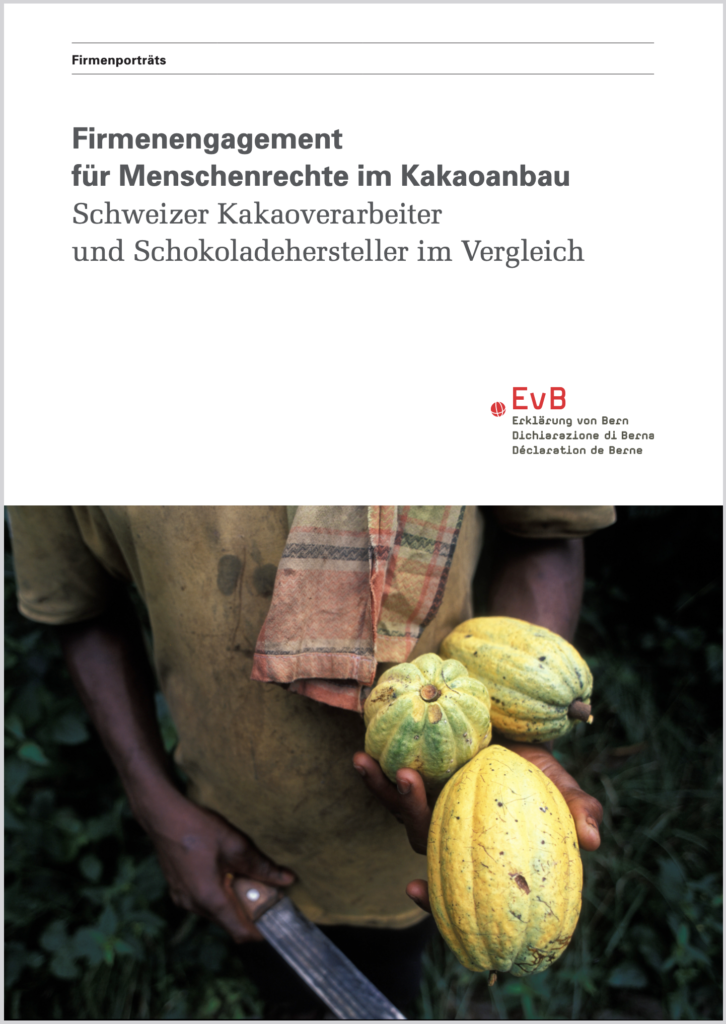
Corporate commitment to human rights in cocoa farming. A comparison of Swiss cocoa processors and chocolate manufacturers
The … results suggest that smaller Swiss cocoa processors and chocolate manufacturers tend to perform better than large corporations. In addition, the deeper the idea of fair and sustainable cocoa production is anchored at a company, the more coherent the strategy for preventing and combating human and labour law violations seems (Source: EvB 2013f, np link).
At the top of the ranking is the cocoa retailer Pronatec from Winterthur. Chocolats Halba is listed as the second responsible company. The company mainly produces for the Swiss retail trade and is part of the Coop Group (Source: Blank 2013, np link).
Large companies operating worldwide such as Nestlé, Lindt & Sprüngli, Barry Callebaut or Kraft Foods, on the other hand, are performing worse. The EvB lists them in the category of ‘negligent’ companies. In this section you will also find the Migros subsidiary Chocolat Frey. At the bottom of the ranking are Camille Bloch – from this company, for example, the brands Ragusa or Torino – and the Confiseur Läderach AG (Source: Blank 2013, np link).
Virtually all companies still fail in terms of full traceability … (Source: EvB 2013f, np link).
… of cocoa raw materials. ‘If you do not know the origin of the original substances of your products, you cannot take action against human and labour law violations during their cultivation and further processing,’ argues Andrea Hüsser, who wrote the study at the EvB (Source: Blank 2013, np link).
The extensive programs developed in recent years, primarily by large corporations, are noteworthy. Despite large investment volumes, these initiatives and programs unfortunately cover only a small portion of the enormous quantities of cocoa required by companies such as Nestlé, Barry Callebaut, Lindt, and Mondelez (formerly Kraft Foods), which have annual sales of over CHF 2 billion. Compared to the surveys conducted [by EvB] in 2009 and 2010, it is clear that the large-scale projects promoted at that time are still in their infancy (Source: EvB 2013f, np link).
[This] disregard for cocoa farmers is coming back to haunt us, because poverty is leading to enormous production problems – there are fears of a significant cocoa supply shortage. Urgently needed investments in plantations and further training cannot be made, resulting in plants that are overaged or diseased. Due to the low incomes in cocoa farming, young people are also migrating or turning to other agricultural commodities. And since farming families cannot afford to pay workers, children are repeatedly employed (Source: EvB 2013d, p.3 link).
Although small successes are visible … [in] initiatives aimed at reducing abusive child labor [in chocolate supply chains] … abusive child labor is rooted in the impoverishment of smallholder families – which is why selective initiatives that focus solely on the abolition of child labor are unlikely to be successful in the long term (Source: EvB 2013f, np link).
Another sticking point is the price policy for cocoa, for which the chocolate companies still campaigned too little. ‘The power gap between the small farmers and the large corporations makes fair price negotiations practically impossible,’ says Hüsser (Source: Blank 2013, np link).
5.5 million cocoa farming families and their 14 million workers work on the cocoa plantations. And receive only 7% of the price of a bar of chocolate (Source: EvB 2013d, p.14 link).
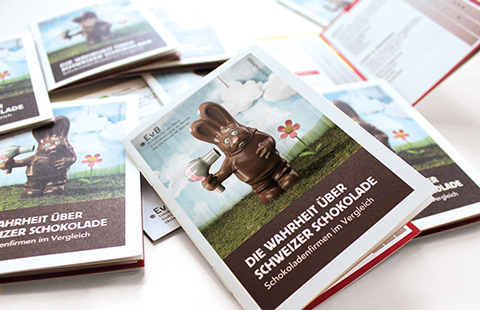
With the help of its suicidal campaign mascot, the EvB … raised consumer awareness of the problems in the cocoa sector … from March 1st until Easter. In the handy chocolate guide [below], chocolate lovers can find out which Swiss companies are truly committed to social sustainability. Detailed information about the companies can be found online in the comprehensive study [above] (Source: Anon 2013d, p.3 link).
[EvB] commissioned PopUpAgency, represented by Benz / Hofer / Textor, to bring these abuses to the attention of the Swiss public. … The campaign is accompanied … the distribution of the EvB …(Source: Anon 2013b, np link).
… handy chocolate guide, [in which] chocolate lovers can find out which Swiss companies are truly committed to social sustainability (Source: Anon 2013d, p.3 link).
[EvB also] commissioned animators / filmmakers Kompost to … (Source: Cook et al 2013, np link).
… [create the campaign’s] visual hook [-] two short animated videos in which a chocolate Easter bunny discovers the truth about how chocolate is made. He learns that cocoa farming families cannot make a living from their work on the plantations, and with this knowledge, he no longer wants to live either (Source: EvB 2013a, np link).
‘The Truth About Swiss Chocolate’ is a gory sequence in which the ultimate weapon[s are] … (Source: Zbinden 2013, np).
… a hair dryer and a hotplate … His attempts however fail, and he is left with the bitter reality (Source: Kompost 2013, np link).
Together with the EvB, he calls for fair and sustainable cocoa production (Source: EvB 2013a, np link).
The two spots [were] seen on TV and online until Easter (Source: Anon 2013b, np link).
[And o]ver 70,000 people … viewed and shared [these] videos (Source: EvB 2013a, np link).
[EvB also commissioned PopUpAgency for] creative and fun … (Source: Ilona 2013, np link).
… Facebook activities (Source: Anon 2013b, np link).
Visiting www.stop-bad-chocolate.ch leads to a Facebook page where you can enter your name and confirm: I’m for fair chocolate! You then receive a virtual chocolate bar with your name on it. The goal is to create the world’s largest virtual chocolate bar – totally fair and for fair trade (Source: Ilona 2013, np link).
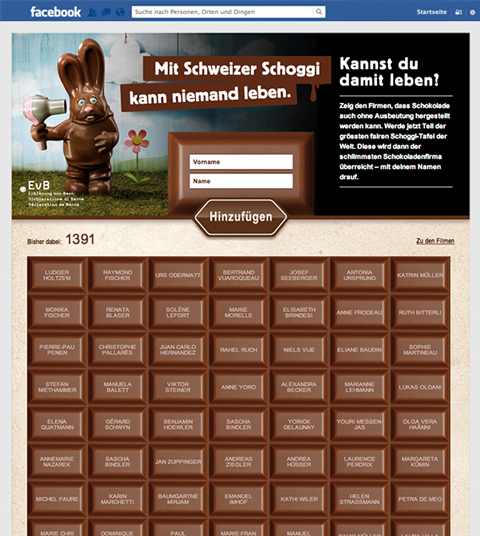
No one can live with Swiss chocolate. Show companies that chocolate can be produced without exploitation. Become one of the largest fair trade chocolate bars in the world. This will then be presented to the most shameful chocolate company – with your name on it (Source: Anon 2013c, np link).
By Easter, over 10,000 people had contributed their names to Switzerland’s largest fair trade chocolate bar …(Source: EvB 2013a, np link).
… [where] each signatory is a piece of chocolate (Source: Schlenker nd, np link).
This was turned into ‘real’ chocolate and presented, along with … (Source: EvB 2013a, np link).
… [EvB’s] central demands … (Source: EvB 2013e, np link).
… to one of the negligent companies: Lindt & Sprüngli. Lindt & Sprüngli is synonymous with Swiss chocolate like no other company at home or abroad (Source: EvB 2013a, np link).
EvB presented L&S [Lindt & Sprüngli] CEO Ernst Tanner with the giant, entirely fair chocolate bar before the general meeting at the Kongresshaus Zurich. This is because ‘his’ company (Tanner is CEO and Chairman of the Board of Directors) represents Swiss chocolate at Easter – keyword ‘Gold Bunny’ – like no other industry representative (Source: EvB 2013j, np link).
However, if L&S really wants to be the industry leader, the company must also meet this standard in the area of human rights. This requires 100% traceability, 100% fair prices, and 100% compliance with human rights along the cocoa supply chain. The giant chocolate bar made from Fair Trade pioneer Claro’s dark chocolate proves that all these criteria are entirely achievable. All the ingredients in the 50-kilogram, 2×1-meter bar are traceable back to the cocoa plantations, and the greatest possible share of its added value was generated by the local farming families. Ernst Tanner accepted the record-breaking fair trade chocolate bar today before the AGM at the Zurich Congress Center, referring to the L&S investments in sustainable procurement announced a few weeks ago (Source: EvB 2013j, np link).
In doing so, he officially acknowledged consumers’ desire for fairly produced chocolate and admitted that there is still much to be done (Source: EvB 2013a, np link).
We are eagerly awaiting their implementation and will continue to follow the measures and their impact with critical interest (Source: EvB 2013j, np link).
As a customer country, Switzerland is challenged [by EvB’s campaign] on three levels. For chocolate companies, a transparent supply chain, measures to comply with labour and human rights and their control are essential. The Swiss state is to oblige companies to report regularly in this regard. Finally, consumers can set an example by preferring chocolate from manufacturers who demonstrate a serious commitment to fair production conditions (Source: EvB 2013d, p.4 link).
Inspiration / Technique / Process / Methodology
Public Eye, formerly a Declaration of Bern (EvB), is a Swiss non-governmental organization (NGO) with around 29,000 members (as of 2025) and offices in Zurich and Lausanne. With investigative research and public campaigns, Public Eye is committed to ensuring that Swiss companies and Swiss politics assume their responsibility for respecting human rights worldwide. … The Declaration of Bern was made in 1968 by a group of predominantly reformed theologians, to which, among other things, André Biéler, Kurt Marti and Max Geiger belonged, in the form of a manifesto on ‘Switzerland and the developing countries’. 1000 people signed this manifesto and pledged to donate 3% of their income to the development cooperation. In 1971, the declaration of Bern was constituted as an association. The association now has more than 28,000 members. It is funded by membership dues, donations, bequests, and project grants. In 2016, the General Assembly decided to rename the organization Public Eye. This was justified by the fact that the new name was self-explanatory, cross-language and well-known to the public through ‘Public Eye on Davos,’ the counter-event to the World Economic Forum (WEF), which was organized by the then Declaration of Bern. … [Its] Schoggi campaign started in spring 2009. The EvB called for transparency and a fair pricing policy so that child labour is not the norm in cocoa production (Source: Wikipedia nd, np link).
Chocolate is not only consumed most extensively in Switzerland with almost 12 kilograms per capita per year, but is also one of the most well-known and popular Swiss export products. Switzerland gives a lot to its ‘schoggi’, but cocoa, its most important component, is often produced under conditions that are far removed from the Swiss commitment to human rights and the humanitarian tradition. The cocoa tree is an important source of income for millions of farmers. The trade in cocoa beans is a tough business with influential players. Around 5.5 million smallholder farmers worldwide are growing cocoa. About a third of the world’s recycled cocoa comes from Ivory Coast. Ghana is the number two in the competition for the cocoa trade with over 20 percent. Indonesia, Nigeria, Cameroon, Brazil and Ecuador produce the majority of the rest. The smallholder families sell the cocoa to cocoa-processing companies that produce precursors for the chocolate producers. The world market for cocoa processing and chocolate production is dominated by a few companies. The lion’s share of value added in the chocolate production chain takes place in the north, as with many other products. Thus, not even seven percent of the production costs of a chocolate bar are accounted for by the south (Source: EvB 2013h, np link).
[In Switzerland] widespread consumer awareness of the working conditions and earnings of producers in the cocoa trade is … lacking … ‘ chocolate has the reputation of being a typical Swiss product … And Swiss products inherently have a clean reputation’ … says Andrea Huesser from … The Bern Declaration (EvB) (Source: cp 2013, np).
The [No one can live with Swiss chocolate] Campaign was launched on March 1, 2013, at the NATUR trade fair in Basel (Source: EvB 2013a, np link).
+35 comments
[It was EvB’s] third campaign on this topic, and since 2009, unfortunately, only minimal progress has been made (Source: Zbinden 2013, np).
[In 2009, t]he … Berne Declaration [EvB] … launched a campaign to encourage the country’s chocolate producers to do more to ensure the cocoa they buy comes from ethical sources. On the cusp of the Easter season the group … released images of chocolate bunny rabbits crying blood, with the slogan, ‘child labour is put into Swiss chocolate’ (Source: Neville 2009, np link).
While no exact figures exist on how many children suffer under forced working conditions in the worldwide cocoa trade, labour groups and human rights activists estimate as many as 250 million children could be affected. The matter first caught the public’s attention about nine years ago as media reports surfaced of forced child labour in West Africa. Officials from the United States-based International Labor Rights Forum investigated the issue. ‘These child workers labour for long, punishing hours, using dangerous tools and facing frequent exposure to dangerous pesticides as they travel great distances in the gruelling heat,’ a report states. ‘Those who labour as slaves must also suffer frequent beating and other cruel treatment.’ The motives for using forced child labour are largely economic. While cocoa prices have climbed from about $718 (SFr855) a ton in 2000 to as high as $2,600 a ton in recent years, cocoa producers in Ivory Coast are among the most heavily taxed group of growers worldwide. Berne Declaration says farmers there keep just 35 cents of every dollar’s worth of beans sold. Producers in other regions can keep as much as 90 cents per dollar. ‘The main problem is that prices aren’t high enough for farmers to survive,’ Hüsser said. ‘They have to employ children or forced labour because they can’t pay anyone to work for them’ (Source: Neville 2009, np link).
Easter time is Schoggizeit. The business with the rabbits and eggs is flourishing. This benefits Swiss chocolate producers, but not those quarter of a million children who work in West Africa for free to obtain the most important ingredient. Since the beginning of February, 6000 consumers have protested against these conditions in writing. Together with the EvB, they require an explanation from the manufacturers of their respective favorite Schoggi. 6,000 people in Switzerland have signed the EvB petition ‘Never again Swiss Schoggi from child labour’ in recent weeks, setting a strong sign. They no longer want to consume sweet symbol carriers of their country, which are made under exploitative working conditions. Therefore, together with the Bern Declaration, the signatories demand transparent information on the conditions of production in the cocoa countries and on their concrete commitment to their improvement. Fair working conditions in the south depend on whether chocolate producers in the north perceive their corporate social responsibility (CSR). Open communication, fair pricing policy and an applied code of conduct, including monitoring and controlling, are important tools for this. The EvB surveyed 18 Swiss companies about these instruments and received only one meaningful response (Source: EvB 2009a, np link).
Six out of 18 companies contacted did not respond, including Nestlé and Barry Callebaut, the world’s two largest chocolate producers (Source: EvB 2009b, np link).
[Chocosuisse, t]he Association of Swiss Chocolate Manufacturers, a cooperative of 18 industrial chocolate companies, says it is working to ensure Switzerland’s world-famous chocolate is produced under fair and ethical practices. ‘We are aware of our social responsibilities as employers and are committed to a social partnership,’ the association says. But the Berne Declaration says the raw material supply chain is not transparent enough for consumers to know for certain that the chocolate they buy is not tainted by child labour. In a cocoa market cluttered by politics, war and cut-throat competition, it can be extremely difficult to pinpoint the conditions under which the beans were produced. ‘We don’t want people to stop eating chocolate, but we need to make people aware that there is a problem in the industry and that producers need to be more transparent,’ Andrea Hüsser … [from] the Berne Declaration, told [us]. ‘They make good chocolate but we want it to be fair’ (Source: Neville 2009, np link).
[To show what’s possible] the EvB has offered consumers an alternative and had 2,200 hand-scooped, organically certified and fairly produced Easter bunnies manufactured. The demand for clean chocolate is immense: after just six weeks, the last rabbit is sold. In addition, the EvB, together with Max Havelaar, will be designing the exhibition area on the subject of Fairtrade-Schoggi at the exhibition ‘100% Schokolade’ in the historic Museum Lucerne. Vernissage is on 2. April. And the campaign continues: In six Swiss cities, signature collection campaigns for the Schoggi campaign will take place in early April (Source: EvB 2009a, np link).
[On] May 28, 2009 – A remarkable 17,826 people [had] signed the EvB petition ‘No More Swiss Chocolate Made with Child Labor’ and helped ensure that some Swiss chocolate companies are making social responsibility a top priority. … The two largest Swiss chocolate companies, Nestlé and Barry Callebaut, have not taken a stand on the intolerable conditions on West African cocoa plantations – not even toward their concerned customers. … [But, t]welve other companies have acknowledged the worried inquiries of their customers with more or less well-founded response letters. … In their reactions, the[y] … point to their commitment to international initiatives. However, these are usually purely financial participations, which are handled via Chocosuisse and are still in the pilot phase after several years. This is not how the child labour problem can be solved. In West Africa, around two million smallholder farmers in the multinational chocolate industry still contribute to sales of almost two billion dollars annually. The farmers themselves remain, of course, low-bed, because there are no price guarantees. People live in direct dependence on the world market price, which the chocolate industry determines significantly. The only factor that the planters can influence in their plight is the cost of manpower. That’s why they send children to the plantations. The fact that a consistent change to Fairtrade chocolate is possible, the British group Cadbury demonstrated a few weeks ago. If the majority of the Swiss chocolate industry remains idle, it will soon be known for producing good but inedible chocolate (Source: EvB 2009b, np link).
EvB conducted a similar survey on the commitment of Swiss cocoa processors and chocolate manufacturers … in 2010 (Source: EvB 2013f, np link).
[Around the same time, t]he 10 Campaign coalition also emerged to redress the failings of the cocoa industry which had not fulfilled its ‘promises to eliminate the Worst Forms of Child Labour in West Africa’s cocoa sector’ … The 10 Campaign is a collective of international organizations including: STOP THE TRAFFIK (United Kingdom, the Netherlands, Belgium, Australia and Canada); The International Labor Rights Forum (United States of America); Südwind Research Institute (Germany); World Vision (Australia); The Berne Declaration ([EvB] Switzerland); Stop Child Labour – School is the best place to work (the Netherlands, Czech Republic, Italy and Denmark); Confédération Syndicale Burkinabé (Burkina Faso); Fairfood International; FNV Bondgenoten (Netherlands) and various individuals with extensive experience in sustainable cocoa … The 10 Campaign introduced a new frame, corporate social accountability, in response to fears of fair-washing occurring in the industry’s CSR … ‘corporate social responsibility‘ (Source: DeLuca-Acconi 2015, p.104 & 204 link).
EvB’s 2012 survey was more detailed, incorporated the UN reference framework for business and human rights, … was newly targeted at 19 rather than 18 firms … (Source: EvB 2013f, np link).
… [and was sent to them in] mid-October (Source: Marti 2012, np link).
The survey focusses on four topics:
1. Traceability within the supply chain and risk analysis;
2. Measures to improve the situation on the cocoa plantations;
3. Control and standards;
4. Transparency and communication.
The questions in the four subject areas were weighted differently. An additional criterion for the valuation is the turnover size of a company … The investigation is based on the companies’ own information as well as on additional Internet research by the EvB. The focus was on human and labour rights. Ecological aspects were not included (Source: EvB 2013d, p.5 link).
With the data collected, the EvB wants to create comparable company portraits, which will be published at the end of February 2013, in order to serve as a guide for the purchase of Easter bunnies. According to the EvB, more than half of those contacted ‘failed to respond’. Only Lindt, Frey, Stella, Halba, Bernrain, and Maestrani responded to the EvB questionnaire by the deadline. Nestlé, Camille Bloch, Pronatec, and Kraft Foods (now Mondelez) sent ‘at least a letter of postponement.’ All other companies ‘either did not respond at all or explicitly refused to provide any information (e.g., Läderach),’ as the EvB writes (Source: Marti 2012, np link).
The results of the survey are clearly presented in a detailed study or in our handy Chocolate Guide [see above] (Source: EvB 2013a, np link).
The presentation is a snapshot … It does not claim to be complete. The evaluation may not be quoted in the form ‘Recommended by the EvB’ or used for advertising purposes (Source: EvB 2013d, p.5 link).
[The report concluded that] Swiss chocolate companies and retailers continue to produce under raw conditions and once again bring the cocoa farming families unhappy Easter. … The discrepancy between social intentions and their implementation has not changed since the last ranking in 2010, nor has the industry transparency. … [Companies’] willingness to respond has increased slightly. [But, o]ver a third …, including Camille Bloch, Chocolat Alprose and Gysi Chocolatier, were not prepared to fill out the EvB questionnaire this time either (Source: EvB 2013b, np link).
[Refused to take part]: Camille Bloch, Chocolat Alprose, Chocolate & Cacaos Favarger, Confiseur Läderach, Gysi Chocolatier Suisse, Max Felchlin, Pfister Chocolatier (Source: EvB 2013d, p.16 link).
[EvB’s] ranking of the most responsible chocolate companies is led by the cocoa retailer Pronatec, followed by Chocolats Halba, where it is mainly produced for Coop. Among the highlights are the giants Mondelez (formerly Kraft Foods), Barry Callebaut, Nestlé and Lindt. … Their main problem is usually the lack of traceability of the cocoa raw materials. Because those who do not know the origin of the original substances of their products cannot take action against human and labour law violations during their cultivation and further processing. In the absence of progress in fair price policy, there are still hardly any improvements in the reduction of improper child labour, after all, it is rooted in the impoverishment of the smallholder farming families (Source: EvB 2013b, np link).
Advanced [chocolate brands]: Pronatec, Chocolate Halba (Source: EvB 2013d, p.16 link).
Among the highlights are the giants Mondelez (formerly Kraft Foods), Barry Callebaut, Nestlé and Lindt (Source: EvB 2013b, np link).
So-so [brands]: Chocolate Frey, Nestlé, Lindt & Sprüngli, Villars Maître Chocolatier, Confiserie Sprüngl, Kraft Foods (Source: EvB 2013d, p.16 link).
Their main problem is usually the lack of traceability of the cocoa raw materials. Because those who do not know the origin of the original substances of their products cannot take action against human and labour law violations during their cultivation and further processing. In the absence of progress in fair price policy, there are still hardly any improvements in the reduction of improper child labour, after all, it is rooted in the impoverishment of the smallholder farming families (Source: EvB 2013b, np link).
The social lip services of the manufacturing and trading giants must finally become tangible improvements for the more than 20 million people living from cocoa cultivation. In addition to transparent, controlled supply chains and comprehensive investments in measures against child labour, this also requires price guarantees that enable cocoa farmers to live a decent life. And for that, it takes pressure on the Swiss chocolate companies (Source: EvB 2013b, np link)!
Transparency regarding the origin and production conditions of products is the fundamental prerequisite for us as consumers to have a genuine choice (Source: Rudolf 2013, p.3 link).
Consumption tips
– Pay attention to product labels. Product labels stand for compliance with certain ecological and social standards and their independent certification by third parties. However, the certificates of Max Havelaar, UTZ, Rainforest Alliance and Bio contain differently rigourous guidelines. The EvB considers the pricing policy of the Max Havelaar standard to be the most progressive.
– Ask the manufacturer of your favourite chocolate for origin and production conditions.
– Enjoy chocolate in the awareness that there is a lot of work in it.
– Continue to eat fairly produced chocolate so that cocoa growers in the south can benefit from demand (Source: EvB 2013d, p.15 link).
Furthermore, disclosure increases the pressure on companies to commit to greater social sustainability. For this reason, the Chocolate Guide formed the starting point of the EvB chocolate campaign before Easter. It provides a sound information base and clarifies which companies credibly put their sustainability promises into practice. Detailed company profiles are also available on [EvB’s] website, allowing you to follow the individual companies’ commitments in detail. However, without disseminating knowledge, raising awareness, and taking action, there is no impact. Therefore, we also used several channels in the [No one can live with Swiss] chocolate campaign to publicize the facts about the companies. Short TV and online spots featuring our suicidal campaign mascot, the bunny, brought the issue closer to people (Source: Rudolf 2013, p.3 link).
… [saying] it’s high time for consumers to cheer up the sad Easter bunnies (Source: EvB 2013b, np link)!
Special thanks to the nearly forty chocolate bunnies who gave up their lives in the making of these movies (Source: Kompost 2013, np link).
Over 70,000 people have viewed and shared our videos (Source: EvB 2013a, np link).
We would [also] like to thank the Fédération genevoise de coopération (FGC), the Fédération vaudoise de coopération (Fedevaco), the Berti Wicke Foundation, the Catholic Church of Lucerne and another foundation for the financial support of the campaign (Source: EvB 2013a, np link).
At the same time, the EvB school visit team encouraged children and young people to question the origin of their favorite chocolate. Street actions organized by regional groups also provided an opportunity to learn about the abuses on cocoa plantations. In addition, concerned consumers contacted the companies directly and virtually contributed to the construction of the largest fair trade chocolate bar on our campaign website. It will be presented to a leading Swiss chocolate company in mid-April – as a symbolic call to action to ensure greater social sustainability (Source: Rudolf 2013, p.3 link).
[In addition, n]early 500 people took part in the traditional Easter March in Bern on April 1, 2013. Visitors were informed about the activities of the EvB. The booths marked the end of the Easter March from Eichholz to the Münster. On March 26, 2013, the public film screening of ‘The Dark Side of Chocolate’ took place at the WWF Education Center, Bollwerk 35 (1st floor) in Bern. Two “bittersweet” street actions took place on March 14 and March 21, 2013, in Bern: www.stop-bad-chocolate.ch/ (Source: EvB 2013k, np link).
In this way, through many small actions, we can collectively make a difference and loudly protest against human rights violations in the cocoa industry (Source: Rudolf 2013, p.3 link).
Discussion / Responses
He’s sweet, the rabbit (Source: @sueru11 2013, np link).
Hmm, but [he] committed suicide (Source: @TheCoolboy257 2013, np link).
Oh dear, poor rabbit! It is unbelievable that the cocoa for Swiss chocolate is grown in the manufacturing countries in Africa under very unworthy circumstances (Source: @tabeazuberbuhler4836 2013b, np link).
CHOCOSUISSE, the association of Swiss chocolate manufacturers, counters that the EvB is resorting to confrontation rather than a more constructive dialogue. As CHOCOSUISSE explains, companies in the Swiss chocolate industry are intensively engaged with the social aspects of cocoa farming, with a focus on West Africa. Nearly all company heads have participated in trips organized by CHOCOSUISSE to Ghana and Ivory Coast in recent years, learning firsthand about production conditions and social circumstances in cocoa farming. These and other trips have enabled them to establish contacts with reliable suppliers of socially responsible cocoa beans. According to a press release, most Swiss chocolate manufacturers have been involved in concrete projects in West Africa and Latin America for years. These projects focus on increasing the quality and productivity of cocoa farming and improving the social conditions of cocoa farmers and their families. CHOCOSUISSE regrets that the EvB … downplays the various projects and activities through which Swiss chocolate companies contribute to alleviating poverty in cocoa-producing regions and fails to recognize that socially responsible cocoa production is possible even without a Fairtrade label. The press release continues: ‘The statements made by the EvB representatives regarding quality, quantity, and prices demonstrate that they are clearly insufficiently familiar with the highly complex cocoa issue and that their texts are based on secondary sources’ (Source: Anon 2013a, np link).
+42 comments
No one can live on Swiss chocolate (Source: Schweiz 2013, np link).
I can deal with it very well! The world today forces me not to let any manufacturing process weigh my conscience (Source: Frischknecht 2013, np link).
Ui, I was not aware that the conditions are so bad in the chocolate production :-(( ( ( ( ( ( ( THat’s crazy (Source: @tabeazuberbuhler4836 2013a, np link).
Oh, poor rabbit… I think we should all do more about fair trade (Source: @Tabbygazelle 2013, np link).
I thought our Swiss chocolate was produced fairly (Source: @TheCoolboy257 2013, np link)?
I only buy Fair Trade chocolate – after all, I don’t want to drive such a cute bunny into the abyss. (Source: @andreasstutzer1139 2013, np link).
Fairtrade-schoggi is unfortunately not always the best (Source: @a_hase 2013, np link).
[It] often tastes a bit too healthy and reasonable (Source: @regulaziegler260 2013, np link).
[But] how much taste do you have if you knowingly support unfairly produced chocolate companies and say it’s none of your business (Source: @estrelladelmar1101 2013b, np link)?
[W]e don’t want even more schoghihasen to reach for the hairdryer (Source: @a_hase 2013, np link).
The … campaign [videos] … are quite funny, but not particularly informative (Source: Ilona 2013, np link).
I would have liked a little more information. Exploiting Schoggi is sad and unnecessary. I am looking forward to the brochure with the fair providers (Source: @regulaziegler260 2013, np link).
[EvB’s] chocolate guide ‘The Truth About Swiss Chocolate’… and the accusation contained therein that ‘Swiss chocolate companies and retailers continue to produce largely unfairly’ led to fierce disputes (Source: Block 2013, p.20 link).
The [EvB’s] criticism … is incomprehensible among the chocolate companies (Source: Blank 2013, np link).
CHOCOSUISSE counters these accusations with its intensive efforts to act in a socially and ethically responsible manner throughout the entire value chain and with the ‘Swiss Chocolate Industry Code of Conduct for Cocoa Procurement,’ and expects dialogue rather than confrontation (Source: Block 2013, p.20 link).
Camille Bloch … strongly defends itself. ‘We answered the [EvB’s] questions in writing and by phone. We explained that as an unlisted family-owned SME, we cannot provide them with all the figures they requested in detail and fill out their form, which is why we are described as opaque,’ says Regula Gerber, communications manager. She goes on to certify that the cocoa used for Ragusa and Torino is ‘100% traceable.’ ‘Thanks to our partnership with Source Trust, we track our cocoa back to the growing regions and work exclusively with cooperatives affiliated with this organization (Source: Gaudard 2013, p.35 link).
When asked … Lindt & Sprüngli [also] … pointed to their collaboration with Source Trust The project aims to improve the situation of the farming families through increases in yields and sustainable cultivation (Source: Blank 2013, np link).
‘If the Lindt partner Source Trust organizes trainings for the farmers to achieve higher yields, this does not mean that their living conditions will also improve,’ explains [EvB’s] campaign manager [Hüsser] (Source: Merkt 2013, np link).
[But] the EvB considers Source Trust, an industry-founded organization, to be insufficiently transparent. Companies like Lindt & Sprüngli and Camille Bloch, which collaborate with Source Trust, therefore feel they are not given enough of a voice, according to their own assessment (Source: cp 2013, np).
‘With a premium product like Lindt chocolate, customers expect the manufacturer to consider social responsibility when sourcing all raw materials,’ confirms [company] CEO Ernst Tanner, citing one of the reasons for Lindt’s recent initiatives. Equally important, however, were two developments that challenged the entire industry: the declining quality of cocoa beans and the increasingly urgent question of the long-term availability of cocoa in sufficient quantities. The quality problems are partly a consequence of the liberalization that the World Bank imposed on West African cocoa-producing countries in the 1990s. To avoid losing World Bank funds, they had to relinquish their state monopoly over the cocoa industry, and especially cocoa exports. As with all market liberalizations, this initially created uncertainty for several years until a new order could be established. … In this environment, Lindt relies on the concept of traceability. ‘Knowing the origin of the cocoa beans all the way back to the farmers is a fundamental prerequisite for Lindt to assume ethical and social responsibility across the entire supply chain,’ says Tanner. ‘Traceability also ensures the control and continuous improvement of the quality and availability of the raw material.’ … Controlled traceability allows Lindt … to influence the social and economic situation of the producers. For every ton of cocoa sourced from Ghana, Lindt pays a premium of $60 – approximately 2 percent of the current futures market price. Half of this goes to the government to finance the system, and the other half to a Ghanaian welfare foundation. The projects financed with these funds are coordinated by the non-profit organization Sourcetrust, which aims to improve the living conditions of cocoa farmers. Lindt played a major role in its founding in 2009; the leading partner is Armajaro, one of the world’s largest commodity traders (Source: Romeo 2011, p.43).
Lindt & Sprüngli also points to its own purchasing and sustainability programs, some of which the EvB … assesses positively. ‘Lindt has developed potential approaches in various areas, such as health issues and the fight against child labor, that could contribute to improving the current situation,’ the report states. ‘However, as with many other companies, these are all still in their infancy.’ Lindt & Sprüngli finds it incomprehensible that its efforts are not being given due consideration. The company maintains that it controls every single step of its chocolate production process and maintains direct contact with the farmers (Source: cp 2013, np).
Nestlé points to its ‘Cocoa Plan’ to help address the difficulties in the cocoa growing areas. Nestlé is also working with the Fair Labor Association to screen the cocoa supply chain. Chocolat Frey sources 70 percent cocoa, which has been certified by the sustainability label UTZ. Confiseur Läderach AG refers to its membership of the World Cocoa Foundation, which is committed to a sustainable cocoa economy (Source: Blank 2013, np link).
Regula Gerber … and Daniel Bloch [also] give specific examples of how ‘Chocolats Camille Bloch SA’ strives for fair cooperation with cocoa producers and nut suppliers from Turkey, from transparency in cocoa cultivation to qualification and support projects for local families to trips to the growing regions to gain a first-hand impression and make decisions based on this (Source: Block 2013, p.20 link).
In addition, [Camille Bloch] pay premiums on each ton of cocoa for farmer training, local infrastructure, and numerous projects.’ She adds that the managers of the Bern-based company, which is ‘committed to the long term,’ ‘cultivate their contacts with our representatives on the ground.’ The Berne Declaration does not directly question the quality of the beans used by the company (Source: Gaudard 2013, p.35 link).
Camille Bloch [also] … assures a commitment to social and sustainable practices, which the owner personally inspected on site. The family business did not complete the [EvB] questionnaire … (Source: cp 2013, np).
.. [which led them, like m]ost companies [to be] … categorized by the EvB as ‘negligent’ or ‘refusers’ (Source: cp 2.013, np).
… ‘[because ]we were unable to evaluate the measures announced by the company’ [explained] Célia Francillon, spokesperson for the [EvB] (Source: Gaudard 2013, p.35 link).
[Another ‘refuser’ company] Felchlin stated that it had not responded to the questionnaire due to the ‘complexity of [its] cocoa procurement’; furthermore, it argued that no comparison could be made with large companies, as the company had a ‘completely different strategic orientation.’ In the Swiss chocolate industry, every company is unique in its own way. However, the goal of the EvB study was precisely to compare these unique characteristics with the issue of human rights compliance. To make a comparison, we need the completed questionnaire with data in a meaningful format. The evaluation system included over 500 indicators and did indeed distinguish between large and smaller companies (Source: EvB 2013a, np link).
[The] EvB did respond in writing. Campaign manager Andrea Huesser … acknowledges that .. companies [like] Camille Bloch and Max Felchlin, are partly acting in a progressive manner. ‘[So, i]t’s a shame that the companies don’t disclose their knowledge. They could potentially serve as role models,’ she says (Source: cp 2013, np).
Pfister Chocolatier has not commented on either the study or the campaign. For the time being, the company does not appear to be interested at all in the debate regarding compliance with labor and human rights (Source: EvB 2013a, np link).
According to the director of Chocosuisse, Franz Schmid, the Swiss chocolate producers do a great deal to improve the living conditions of cocoa farmers and their families (Source: Merkt 2013, np link).
But … these efforts fail to convince the EvB. At the grassroots level, among small farmers, nothing has trickled down yet, says [EvB] study author Hüsser: ‘There’s a lot of talk, but almost no action’ (Source: Blank 2013, np link).
[For example, ‘t]raceability is the first step needed to even be able to source socially responsible raw materials,’ says … Hüsser. However, this alone by no means guarantees social sustainability. (Source: Romeo 2011, p.43).
[It] alone does not guarantee cocoa farmers better conditions. ‘The biggest problem is the low purchase prices, which also fluctuate extremely,’ explains … Hüsser … For the farmers, stable and living prices are important, with which they can also afford a doctor or school education for their children, for example (Source: Merkt 2013, np link).
Furthermore, Lindt only collects origin information for the beans used to produce cocoa mass. ‘The purchased cocoa butter is not traceable.’ Lindt confirms this; however, the required quantity is disproportionate to the amount of cocoa butter needed, as the beans also contain cocoa butter (Source: Romeo 2011, p.43).
‘If you include the purchase of cocoa butter, the traceability at Lindt & Sprüngli is reduced to less than half of the cocoa beans related,’ explained [EvB’s] Hüsser. She acknowledges that there have been improvements at Lindt & Sprüngli, but the guidelines that the company is guided by remains in the dark (Source: Merkt 2013, np link).
Moreover, [Hüsser] argues, chocolate manufacturers have only taken action because of the looming threat of a future cocoa bean shortage. ‘Behind this supposedly ethical behavior lie hard-nosed economic interests,’ says Hüsser (Source: Blank 2013, np link).
‘Companies that make such high profits, like Lindt & Sprüngli (271.9 million francs) or Nestlé (10.6 billion francs), clearly have the resources to accelerate their programs to make the cocoa supply chain more transparent, reduce farmer poverty, and thus decrease child labor,’ explains Célia Francillon … at the [EvB]. … Nestlé points out, however, that a single company cannot solve labor standards issues in the cocoa sector (Source: Wurlod 2013, p.68).
‘If Lindt & Sprüngli were to stand up for 100 percent fair prices and 100 percent compliance with human rights, this would have a signal effect for the entire industry, emphasizes [EvB’s] Hüsser (Source: Merkt 2013, np link).
[I]t is an illusion to think that all problems can be solved from Switzerland. ‘The main cause of the problems is poverty in these countries,’ [Chocosuisse’s Franz] Schmid [explains]. ‘Swiss chocolate producers are very committed to improving the situation in the villages of cocoa farmers’ (Source: Merkt 2013, np link).
‘It is true that today, the quantity of [Fair Trade and other] certified cocoa produced is not [currently] sufficient to meet the needs of major retailers,’ [EvB] concedes in its report (Source: Wurlod 2013, p.68).
[M]eeting all the requirements of the EvB is impossible (Source: Merkt 2013, np link).
‘A consultative approach, involving industry, government, and non-governmental organizations, is necessary to achieve effective long-term solutions,’ [says Nestlé’s] Meike Schmidt. Initial proposals for this sector, which represents some $9 billion in global revenue, were developed at the first World Cocoa Conference at the end of last year. Industrialists, traders, governments, NGOs, and other experts, meeting in Abidjan, agreed on an agenda to ensure a ‘sustainable’ cocoa economy, capable of transforming cocoa farms into modern businesses and providing fair incomes. The major challenge in the coming years will indeed be to invest massively to encourage the establishment of certified production, which is therefore considered socially and environmentally responsible (Source: Wurlod 2013, p.68).
Outcomes / Impacts
Since the EvB’s first campaign on cocoa in 2009, there have been some developments in the industry, but little has actually been implemented (Source: EvB 2013h, np link).
Although we were able to prompt some companies to respond [to our campaign] on Facebook, unfortunately none of them was able to confirm specifically whether the price they pay for cocoa provides cocoa-farming families with a living wage. In response to a request from the Facebook community, Confiserie Sprüngli announced that it would publish its supplier code, which is scheduled to be completed by the end of 2013. We welcome this step toward greater transparency. We will, of course, then scrutinize the code closely. Lindt & Sprüngli, however, regrets being classified in the ‘Negligent’ category and finds this incomprehensible, as the company is convinced that it sources sustainable cocoa through its partnership with Source Trust. Lindt does not address the EDB’s accusation that Source Trust lacks transparency for the general public. The company also obscures the fact that it can trace only 45% of the cocoa raw materials it uses by referring solely to the traceability of the purchased cocoa beans, which actually stands at nearly three-quarters. On a positive note, however, Lindt & Sprüngli has made some informative updates to its CSR page following the creation of the company profile. In response to the Facebook inquiries, Cailler (Nestlé) refers to its Cocoa Plan, through which Nestlé aims, among other things, to increase farmers’ crop yields, improve traceability, and purchase partially certified cocoa. However, rising yields threaten to drive down prices for individual families. Mondelez (formerly Kraft Foods) has once again drawn the Facebook community’s attention to its $400 million investment, which the company plans to make in its Cocoa Life program over the next ten years. This amounts to $40 million per year. By comparison, Mondelez generated $14 billion in revenue in 2011. So far, Mondelez has published nothing more than a press release regarding its plans (Source: EvB 2013a, np link).
Lindt-&-Sprüngli CEO Ernst Tanner interpreted the handed-over giant [Fair Trade] chocolate [bar] as recognition of the EVB for the efforts that Lindt & Sprüngli is already making. ‘Together with our partner Source Trust, we are building schools and wells,’ Tanner emphasized in front of the press. His media spokeswoman Sylvia Kälin also put the efforts of Lindt & Sprüngli in terms of fair chocolate in the foreground. ‘With three-quarters of our cocoa beans, we know where and how they are produced,’ Kälin [stated] (Source: Merkt 2013, np link).
The disregard shown toward cocoa farmers by powerful cocoa producers and processors is now slowly coming back to haunt them, as poverty is leading to enormous production problems: there are fears of a significant cocoa supply shortage. Urgently needed investments in the plantations themselves and in training cannot be made. As a result, the cocoa trees are overaged or diseased. Furthermore, due to the low incomes in cocoa farming, the younger generation is migrating or turning to other agricultural commodities. And since farming families cannot afford to pay workers, children continue to be employed (Source: EvB 2013h, np link).
+1 comment
Over the last years, civil society has increasingly started to come together, especially in Europe. Various individual NGO’s and networks have run campaigns, such as … Berne Declaration’s campaigns on human rights in cocoa … The VOICE Network has collectively engaged in advocacy, as well as information-sharing with farmers and civil society from the Global South. At the same time many individual NGO’s implement programmes in producing nations or engage in advocacy work. Cocoa farmers are in the first stages of regional and international cooperation, with the launching of various networks of cocoa farmer organizations (Source: Sommeregger et al 2016, p.58).
Page compiled by Ian Cook (last edited March 2026).
Sources
@a_hase (2013) Comment on Public Eye – Focus on Global Justice (2013a) Rohe Ostern: Lebensmüder Osterhase braucht deine Hilfe! – Teil 1. YouTube.com 28 February (https://www.youtube.com/watch?v=TwWrKrPdgzU last accessed 18 February 2026, translated from German by Google Translate)
@andreasstutzer1139 (2013) Comment on Public Eye – Focus on Global Justice (2013a) Rohe Ostern: Lebensmüder Osterhase braucht deine Hilfe! – Teil 1. YouTube.com 28 February (https://www.youtube.com/watch?v=TwWrKrPdgzU last accessed 18 February 2026, translated from German by DeepL)
@estrelladelmar1101 (2013) Comment on Public Eye – Focus on Global Justice (2013b) Rohe Ostern: Lebensmüder Osterhase braucht deine Hilfe! – Teil 2. YouTube.com 28 February (https://www.youtube.com/watch?v=ph3m9LC_pfM last accessed 18 February 2026, translated from German by Google Translate)
@regulaziegler260 (2013) Comment on Public Eye – Focus on Global Justice (2013a) Rohe Ostern: Lebensmüder Osterhase braucht deine Hilfe! – Teil 1. YouTube.com 28 February (https://www.youtube.com/watch?v=TwWrKrPdgzU last accessed 18 February 2026, translated from German by Google Translate)
+46 sources
@sueru11 (2013) Comment on Public Eye – Focus on Global Justice (2013a) Rohe Ostern: Lebensmüder Osterhase braucht deine Hilfe! – Teil 1. YouTube.com 28 February (https://www.youtube.com/watch?v=TwWrKrPdgzU last accessed 18 February 2026, translated from German by Google Translate)
@Tabbygazelle (2013) Comment on Public Eye – Focus on Global Justice (2013a) Rohe Ostern: Lebensmüder Osterhase braucht deine Hilfe! – Teil 1. YouTube.com 28 February (https://www.youtube.com/watch?v=TwWrKrPdgzU last accessed 18 February 2026, translated from German by Google Translate)
@tabeazuberbuhler4836 (2013a) Comment on Public Eye – Focus on Global Justice (2013a) Rohe Ostern: Lebensmüder Osterhase braucht deine Hilfe! – Teil 1. YouTube.com 28 February (https://www.youtube.com/watch?v=TwWrKrPdgzU last accessed 18 February 2026, translated from German by Google Translate)
@tabeazuberbuhler4836 (2013b) Comment on Public Eye – Focus on Global Justice (2013b) Rohe Ostern: Lebensmüder Osterhase braucht deine Hilfe! – Teil 2. YouTube.com 28 February (https://www.youtube.com/watch?v=ph3m9LC_pfM last accessed 18 February 2026, translated from German by Google Translate & DeepL)
@TheCoolboy257 (2013) Comment on Public Eye – Focus on Global Justice (2013) Rohe Ostern: Lebensmüder Osterhase braucht deine Hilfe! – Teil 1. YouTube.com 28 February (https://www.youtube.com/watch?v=TwWrKrPdgzU last accessed 18 February 2026, translated from German by Google Translate)
Anon (2013a) CHOCOSUISSE verwehrt sich gegen Erklärung von Bern. Sweets Global Network, 25 March (https://www.sg-network.org/de/login?redirect=https://www.sg-network.org/de/news/20130325-chocosuisse-verwehrt-sich-gegen-erklarung-von-bern&sample_type=news last accessed 18 February 2026, translated from German by Google Translate)
Anon (2013b) Schoggi-Hase mit mörderischem Fön. persoenlich.com, 6 March (https://www.persoenlich.com/kategorie-werbung/schoggi-hase-mit-moerderischem-foen-304991 last accessed 18 February 2026, translated from German by Google Translate and DeepL)
Anon (2013c) Mit Schweizer Schokolade kann niemand leben. m&k, 6 March (https://www.markt-kom.com/de/markom/mit-schweizer-schokolade-kann-niemand-leben/ last accessed 19 February 2026, translated from German by Google Translate and DeepL)
Anon (2013d) Die Wahrheit über Schweizer Schoggi. erklärung 2 April, p.1-3 (https://issuu.com/erklaerungvbern/docs/erklaerung_april_2013 last accessed 19 February, translated from German by Google Translate)
Blank, V. (2013) Ist Schweizer Schoggi unfair produziert? 20 Minuten 1 March (https://www.20min.ch/story/ist-schweizer-schoggi-unfair-produziert-803979517150 last accessed 18 February 2026, translated from German by Google Translate & DeepL)
Block, V. K-D . (2013) Die Schokoladenseite der Schweiz. block spezial 06 19 September, p.20-21 (https://www.block-schrift.de/fileadmin/media/Spezial/block_spezial_06_Schokolade.pdf last accessed 22 February 2026, translated from German by DeepL)
Cook et al, I. (2013) hat if Easter bunnies knew the truth about chocolate? followtheblog.org, 17 March (https://followtheblog.org/2013/03/17/what-if-easter-bunnies-knew-the-truth-about-chocolate/ last accessed 18 February 2026)
cp (2013) CH/Schokoladeproduzenten werden von Entwicklungsorganisation kritisiert. AWP Premium Swiss News 27 March
DeLuca-Acconi, R.A. (2015) The Power of Advocacy in Bridging the Ideological Divide: The Campaign for Human Rights and Corporate Responsibility in the Cocoa Industry 2001-2014. PhD thesis: Stony Brook University (https://www.proquest.com/docview/1759626289?pq-origsite=gscholar&fromopenview=true&sourcetype=Dissertations%20&%20Theses last accessed 22 February 2026)
Deluz (2013) L’indigestion de lapins en chocolat. La Tribune de Geneve 5 April. p.11
EvB (2009a) 6000 Protestnoten: Unfrohe Osterbotschaft für Schweizer Schoggihersteller. evb.ch, 31 March (https://www.publiceye.ch/de/mediencorner/medienmitteilungen/detail/6000-protestnoten-unfrohe-osterbotschaft-fuer-schweizer-schoggihersteller last accessed 18 February 2026, translated from German by Google Translate & DeepL)
EvB (2009b) Schoggi aus Kinderarbeit: Nestlé und Barry ignorieren Kundensorgen. evb.ch, 28 May (https://www.publiceye.ch/de/mediencorner/medienmitteilungen/detail/schoggi-aus-kinderarbeit-nestle-und-barry-ignorieren-kundensorgen last accessed 18 February 2026, translated from German by Google Translate & DeepL)
EvB (2013a) Erfolgreiche Schoggikampagne 2013. evb.ch (https://web.archive.org/web/20140222124524/http://www.evb.ch/schoggi last accessed 18 February 2026, archived 22 February 2014, translated from German by Google Translate & DeepL)
EvB (2013b) Rohe Ostern: EvB-Studie zeigt Menschenrechtsmängel in Schweizer Schoggi. evb.ch, 1 March (https://web.archive.org/web/20160829010028/https://www.evb.ch/medien/medienmitteilung/rohe_ostern_evb_studie_zeigt_menschenrechtsmaengel_in_schweizer_schoggi/ last accessed 18 February 2026, archived 22 February 2014, translated from German by Google Translate)
EvB (2013c) Schoggi-Guide (2013). evb.ch (https://web.archive.org/web/20140411202825/http://www.evb.ch/p21175.html last accessed 18 February 2026, archived 22 February 2014, translated from German by Google Translate)
EvB (2013d) Die Wahrheit Über Schweizer Schokolade: Schokoladenfirmen im Vergleich. Bern: Erlarung von Bern (https://web.archive.org/web/20150221071215/http://www.tdh-agbasel.ch/EvB_Schoggi_Guide.pdf last accessed 18 February 2026, archived 21 February 2015, translated from German by Google Translate & DeepL)
EvB (2013e) Fotos der Schoggi-Übergabe an Lindt & Sprüngli. evb.ch (https://web.archive.org/web/20140213020737/http://www.evb.ch/p21363.html last accessed 19 February 2026, archived 13 February 2014, translated from German by Google Translate)
EvB (2013f) Die Wahrheit über Schweizer Schokolade. evb.ch (https://web.archive.org/web/20140417214730/http://www.evb.ch/p21198.html last accessed 19 February 2026, archived 13 February 2014, translated from German by Google Translate & DeepL)
EvB (2013g) Forderungen. evb.ch (https://web.archive.org/web/20130531033817/http://www.evb.ch/p21218.html last accessed 19 February 2026, archived 31 May 2013, translated from German by Google Translate)
EvB (2013h) Menschen- und Arbeitsrechte im Kakaoanbau. evb.ch (https://web.archive.org/web/20130605003606/http://www.evb.ch/p21222.html last accessed 19 February 2026, archived 31 May 2013, translated from German by Google Translate)
EvB (2013i) Firmenengagement für Menschenrechte im Kakaoanbau. Schweizer Kakaoverarbeiter und Schokoladehersteller im Vergleich. Bern: Erklärung von Bern (https://www.publiceye.ch/fileadmin/doc/Schokolade/2013_PublicEye_Firmenengagement_fuer_MR_im_Kakaoanbau_Report.pdf last accessed 19 February 2026, archived 31 May 2013, translated from German by Google Translate)
EvB (2013j) GV-Aktion: Faire Riesen-Schoggi soll Lindt auf die Sprüngli helfen. Public Eye, 18 April (https://www.publiceye.ch/de/mediencorner/medienmitteilungen/detail/gv-aktion-faire-riesen-schoggi-soll-lindt-auf-die-spruengli-helfen last accessed 19 February 2026, transleted from German by DeepL)
EvB (2013k) Jahresrückblick 2013 Regru Bern. Public Eye, 18 April (https://www.publiceye.ch/de/news/detail/jahresrueckblick-2013-regru-bern last accessed 25 February 2026, transleted from German by DeepL)
Frischknecht, D. (2013) @jGrene_jVertEs @srf3 I can deal with it very well! … twitter.com 7 March (https://x.com/Dirk_Frischkn/status/309612446732124160?s=20 last accessed 22 February 2026, translated from German by x.com)
Gaudard, A. (2013) Le Ragusa est-il inéquitable? Economie 3 March (https://laboress-afrique.org/boostsess/public/uploads/pdfdocuments/files/ragusa_inequitable.pdf last accessed 22 February 2026, translated from French by DeepL).
Ilona (2013) Zu Ostern: Schoko ohne Kinderarbeit. fuereinebesserewelt.info 5 March (https://www-fuereinebesserewelt-info.translate.goog/zu-ostern-schoko-ohne-kinderarbeit/?_x_tr_sl=de&_x_tr_tl=en&_x_tr_hl=en&_x_tr_pto=sc last accessed 19 February 2026, translated from German by Google Translate)
Kompost (2013) Kompost helps Swiss Chocolate Bunnies melt away. kompost.tv, 6 March (https://web.archive.org/web/20130726043209/http://kompost.tv/blog/?p=732 last accessed 18 February 2026, archived 26 July 2013, translated from German by Google Translate)
Lindt Chocolate World (2015) LINDTGoldbunny. YouTube.com, 26 February (https://youtu.be/lt1X3yf5WAk?si=-H9bU0ZjmM3v7M9X last accessed 19 February 2026)
Marti, K. (2012) Intransparente Schweizer Schokolade-Produzenten. infosperber.ch, 30 November (https://www.infosperber.ch/politik/welt/intransparente-schweizer-schokolade-produzenten/ last accessed 18 February 2026, translated from German by Google Translate and DeepL)
Merkt, A. (2013) Süsse Warnung für den Schoggi-König. bernerzeitung.ch, 18 April (https://www.bernerzeitung.ch/suesse-warnung-fuer-den-schoggi-koenig-156682614837 last accessed 18 February 2026, translated from German by Google Translate)
Neville, T. (2009) Child labour threatens chocolate’s sweet image. swissinfo.ch, 12 March (https://www.swissinfo.ch/eng/banking-fintech/child-labour-threatens-chocolate-s-sweet-image/987422 last accessed 22 February 2026)
Public Eye – Focus on Global Justice (2013a) Rohe Ostern: Lebensmüder Osterhase braucht deine Hilfe! – Teil 1. YouTube.com 28 February (https://www.youtube.com/watch?v=TwWrKrPdgzU last accessed 18 February 2026, translated from German by Google Translate)
Public Eye – Focus on Global Justice (2013b) Rohe Ostern: Lebensmüder Osterhase braucht deine Hilfe! – Teil 2. YouTube.com 28 February (https://www.youtube.com/watch?v=ph3m9LC_pfM last accessed 18 February 2026, translated from German by Google Translate)
Romeo, R. (2011) Lindt & Sprüngli geht neue Wege im Einkauf von Kakaobohnen. Tages-Anzeiger 19 September, p.45
Rudolf, S. (2013) Gemeinsam für mehr faire Schoggi. erklärung 2 April, p.3 (https://issuu.com/erklaerungvbern/docs/erklaerung_april_2013 last accessed 19 February, translated from German by Google Translate)
Schlenker, U. (nd) Kurz notiert: Facebook-Petition, Twitter-Verstärker, Praxis-Handbuch. Kampagne 2.0 (https://www.kampagne20.de/kurz-notiert-facebook-petition-twitter-verstarker-praxis-handbuch/#more-1029 last accessed 22 February 2026, translated from German by DeepL)
Schweiz, J.G. (2013) @Dirk_Frischkn @srf3 @erklaerung Mit Schweizer Schoggi kann niemand leben … twitter.com 7 March (https://x.com/jungegruene_ch/status/309608978948702208?s=20 last accessed 22 February 2026, translated from German by x.com)
Sommeregger, C., Wildenberg, M. & Anane, M. (2016) Bittersweet Chocolate. The Truth Behind the International Chocolate Industry. Wein: Sudwind
Wagner, M. (nd) Die Wahrheit über Schweizer Schokolade. ecowoman.de (https://www.ecowoman.de/die-wahrheit-ueber-schweizer-schokolade-kakaoanbau-unter-menschenrechtswidrigen-bedingungen-2253 last accessed 18 February 2026, translated from German by Google Translate)
Wikipedia (nd) Public Eye. Wikipedia (https://de.wikipedia.org/wiki/Public_Eye last accessed 18 February 2026, translated from German by Google Translate & DeepL)
Wurlod, O. (2013) Chocolat, goût amer. Tribune de Genève 28-29 March, p.8
Zbinden, V. (2013) Un livre et un guide dénoncent l’opacité de la filière du chocolat; La Déclaration de Berne veut mobiliser les consommateurs sur les conditions de production de leur drogue préférée, à la veille de l’overdose pascale. Le Temps 2 March, np
